A Competitive Intelligence Framework for Consumer Brand Teams
Paper still life of a two-by-two grid of cream and peach tiles, one orange tile with a white upward arrow, a paper magnifying glass and two small product bottles

A competitive intelligence framework helps consumer brands keep track of what competitors are doing and how shoppers respond including tracking changes in products, pricing, packaging, and retail availability with consumer feedback about each SKU.

But for many brands, competitor analysis is still a bi-annual (sometimes even annual) event. By then, a competitor can cut prices, a product can go viral, or shoppers can already be recommending cheaper alternatives on Reddit.

So, how does one turn this exhausting, daunting task to a weekly habit? Look at how e.l.f. Cosmetics approaches competition. When a prestige primer became a bestseller at $52, e.l.f. saw an opportunity to offer something similar at a fraction of the price, which went on to sell over 9x as many units as the original in a later 12-month comparison.

e.l.f. has a name for this broader strategy: “first-to-mass.” In its SEC filings, the company describes bringing trends from prestige beauty to the mass market, offering shoppers similar benefits at more accessible prices.

The cosmetics brand also pays close attention to what its customers want. The brand reads comments under its social posts, takes requests during TikTok and Instagram lives, and uses that feedback to develop new products.

If I had to classify e.l.f.'s approach, I'd say it combines four things:

  • Competitive benchmarking: Studying successful competitor products to identify what shoppers are already buying and where there's room to offer something different
  • Social listening: Following customer conversations to understand what people like, dislike, and wish brands would make
  • Consumer feedback loop: Bringing those requests into product development rather than leaving them in the comments
  • Jobs to Be Done thinking: Looking beyond the product itself to understand what shoppers want to accomplish; in this case, getting a smooth base for their makeup without paying prestige prices

Notice how these activities feed into each other? That’s how competitors become part of your daily reality. Here's how this continuous competitive intelligence cycle works:
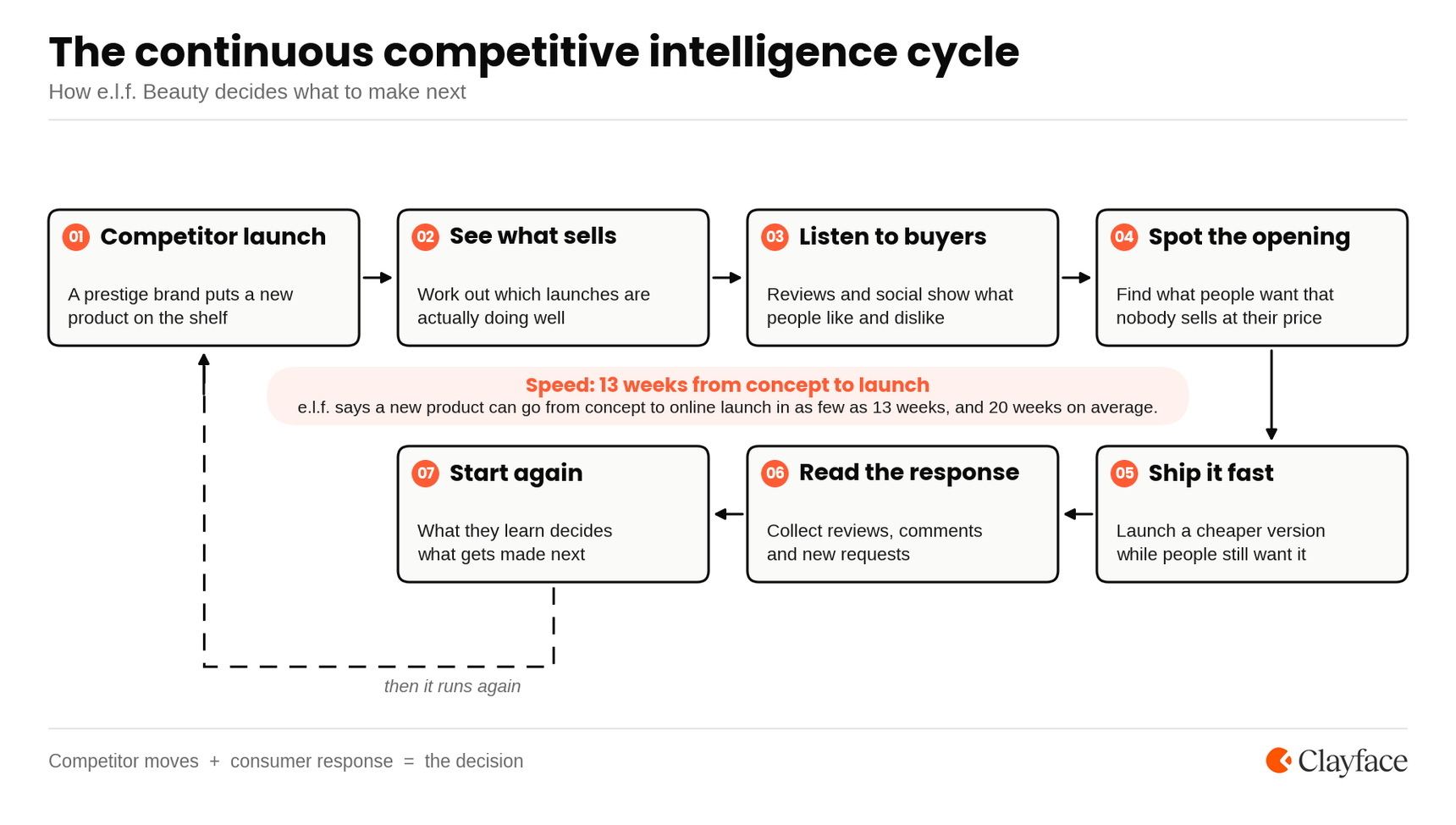
Seven-step continuous competitive intelligence cycle showing how e.l.f. Beauty turns competitor launches into new products

In this guide, I’ll explore the different competitive intelligence frameworks consumer brands use, where each works best, and how to build one that fits your own brand.

5 competitive intelligence frameworks consumer brands use

There are several frameworks you can use to analyze competitors.

Say a competitor cuts the price of its bestselling shampoo from $12 to $9. The 6Ps framework can help you compare the new offer, while Jobs to Be Done can help you understand whether the lower price is enough to make customers switch.

What I'm going to help you focus on is finding your framework and building a repeatable process. Let's start with five established approaches worth understanding:

FrameworkWhat it helps consumer brands doExampleWhat you still need to add
3Cs FrameworkFind a competitive advantage by examining customers, competitors, and your company's capabilities togetherA dairy brand sees demand for protein-rich snacks, rivals focusing on bars, and an opportunity to use its yogurt expertiseRegular product and consumer monitoring
4Ps / 6Ps FrameworkEvaluate how a product competes through its offering, pricing, distribution, packaging, positioning, and promotionsA sunscreen brand compares a rival's SPF, price, packaging, retail placement, and advertising before planning its launchEvidence of how shoppers respond to those choices
SWOT AnalysisSeparate internal strengths and weaknesses from external opportunities and threatsA cereal brand maps strong customer loyalty as a strength, high costs as a weakness, protein demand as an opportunity, and private labels as a threatFresh evidence to keep the assessment current
Jobs to Be Done (JTBD)Understand the underlying task consumers want to accomplish, including why they might choose a different product categoryA parent buying frozen meals wants dinner ready in 10 minutes. Meal kits, takeout, and frozen food all compete for that jobMonitoring of brands addressing those needs
Competitive Intelligence CycleTurn competitor research into a repeatable process of collection, analysis, sharing, action, and reviewA team detects a rival's launch, analyzes customer reactions, briefs product managers, tests a response, and reviews the resultsDefined data sources, monitoring frequency, and team responsibilities

Let me show you how 2 consumer brands have combined and applied these competitive intelligence frameworks to actual products.

1. How Unilever uses the 6Ps to improve product competitiveness

Unilever's Unmissable Brand Superiority framework evaluates products across six factors: Product, Price, Place, Proposition, Promotion, and Pack. Dove's Serum Shower Collection, launched in North America in 2024, is a useful example of how these factors can work together.

Mintel's research found that 92% of surveyed US body wash users considered caring for their body skin as important as facial skincare.

Dove responded with body washes containing familiar facial skincare ingredients such as hyaluronic acid, salicylic acid, and vitamin C. But the approach went beyond formulation. Dove also introduced premium packaging, positioned the collection as accessible premium body care, and brought it to mass retail channels.

Here's how the launch fits the 6Ps framework:
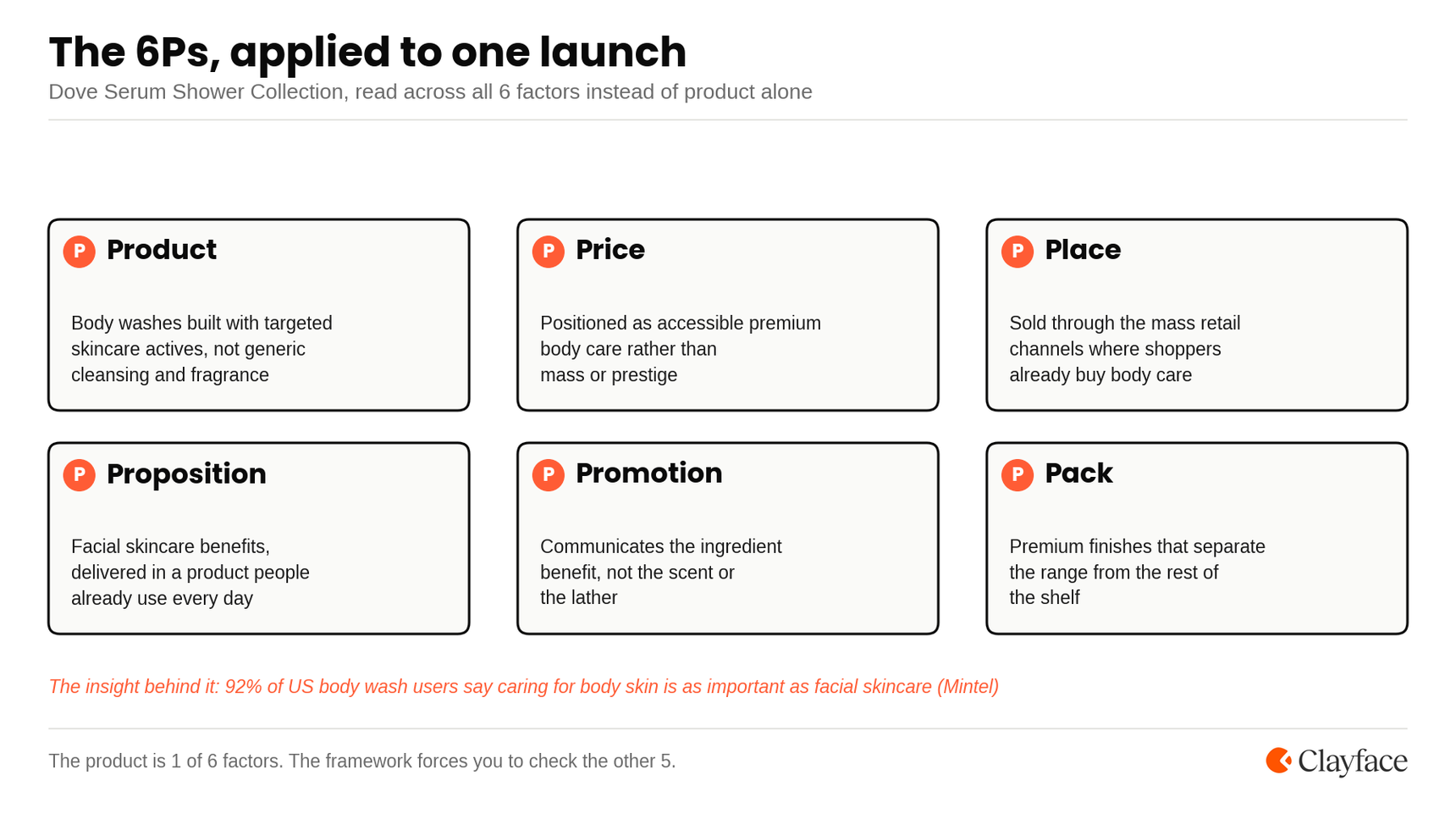
The 6Ps framework applied to Dove’s Serum Shower Collection across product, price, place, proposition, promotion and pack

The 6Ps helps brands evaluate how well their product, pricing, positioning, and distribution work together. But consumer research is what helps establish which benefits shoppers actually want.

2. How P&G used Jobs to Be Done to rethink dish soap

Jobs to Be Done focuses on what consumers are trying to accomplish rather than the products they're using.

Traditional dish soap was designed for a familiar routine of filling the sink, washing the dishes, and rinsing them afterward. But P&G's research found that 61% of Americans were cleaning dishes as they cooked instead of letting them pile up.

This gave P&G a different problem to solve. People wanted to wash a plate or pan while cooking, without filling the sink or waiting for stubborn grease to soak. After five years of development, the brand launched Dawn Powerwash, a spray-on cleaner designed for exactly that routine.

This is what makes Jobs to Be Done useful. Rather than improving the existing dish soap formula alone, P&G looked at how people's cleaning habits had changed and developed a product around them.

Find out what shoppers in each market are asking for

Clayface tracks conversations across Reddit, TikTok, and other platforms, organizing them by region, product, and recurring requests. See where customer preferences differ before the next launch.

Request a demo

How to build a competitive intelligence framework for consumer brands in 6 steps

I recommend a Consumer Response Framework that extracts the most useful elements of the 3Cs, 6Ps, Jobs to Be Done, and the continuous intelligence cycle and combines them.

But for consumer brands, I recommend taking this one step further by examining every important product or SKU, both yours and your competitors', through 4 layers:

  1. Marketed: What the brand promises through its product pages, packaging, and advertising
  2. Product: What the product actually offers, including its formulation, specifications, size, and price
  3. Reviews: What customers say after purchasing and using the product
  4. Conversations: What people discuss, compare, recommend, or complain about across social media and online communities

For example, a competitor might advertise a long-lasting foundation, but customers repeatedly complain that it oxidizes after a few hours. That's a product weakness your brand could address.

Here's how the four layers work together:
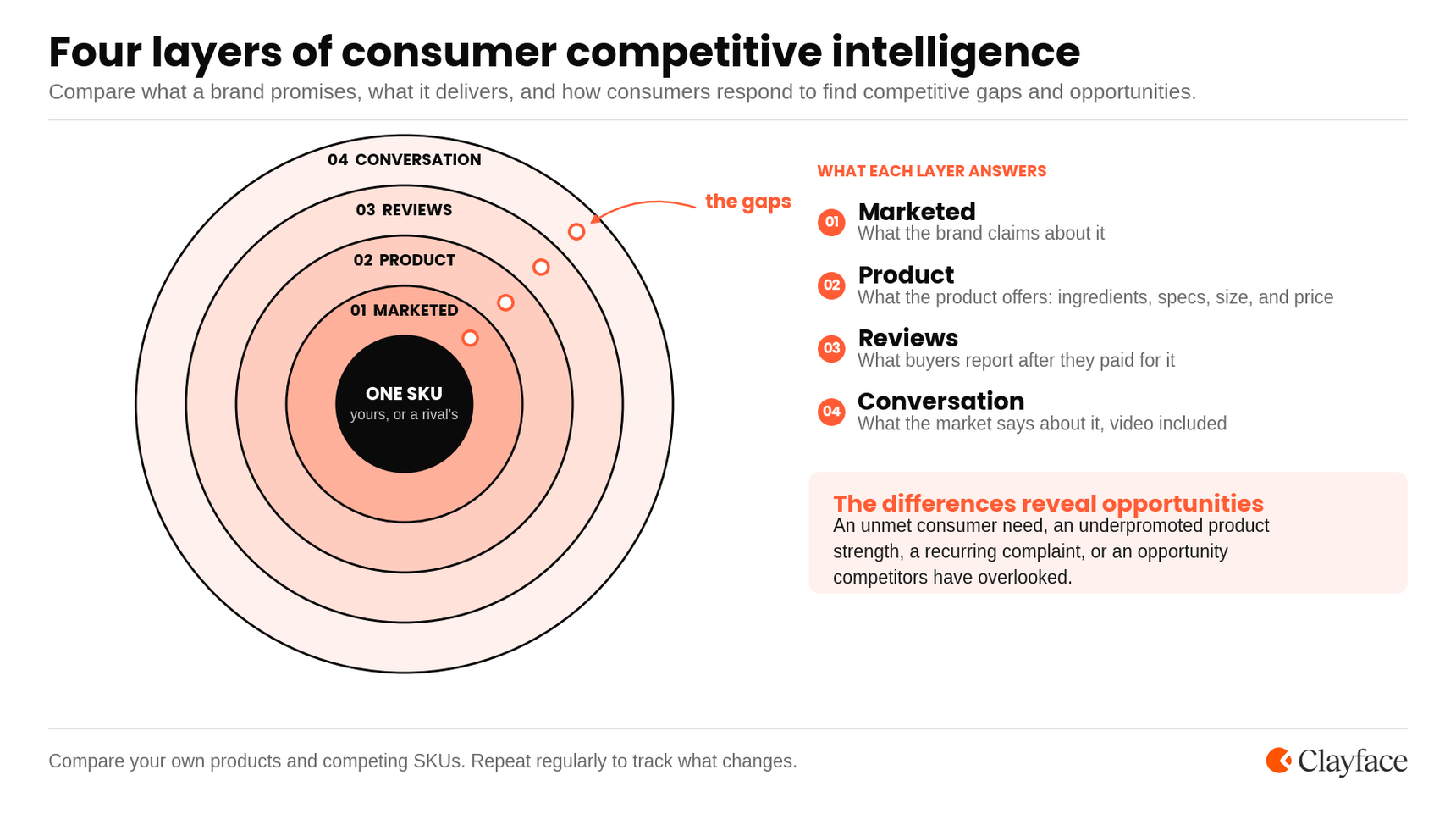
Concentric diagram of the 4 layers of a consumer competitive intelligence framework: marketed, product, reviews and conversation
4 layers of a consumer competitive intelligence framework: marketed, product, reviews and conversation

Now, let's look at how to build and implement this competitive intelligence framework in six steps.

A competitive intelligence tracker you can copy

Before you start reading deeper, I've put together a free editable consumer response tracker you can use to apply the six-step competitive intelligence framework to your own brand.

There's a filled-in example to show you how it works. Start with one product, add the competitors your customers are considering, and build from there.

You can update it weekly as new conversations emerge and share it with your team.

Step 1. Define what you want your competitive intelligence to achieve

Before you start collecting competitor data, decide what business question you're trying to answer.

A clear objective gives teams something specific to work toward. Look at this Reddit discussion about Lululemon leggings, where a shopper wanted a cheaper alternative to leggings costing around $100. Other shoppers recommended brands like CRZ Yoga, comparing fabric softness, fit, durability, and price.
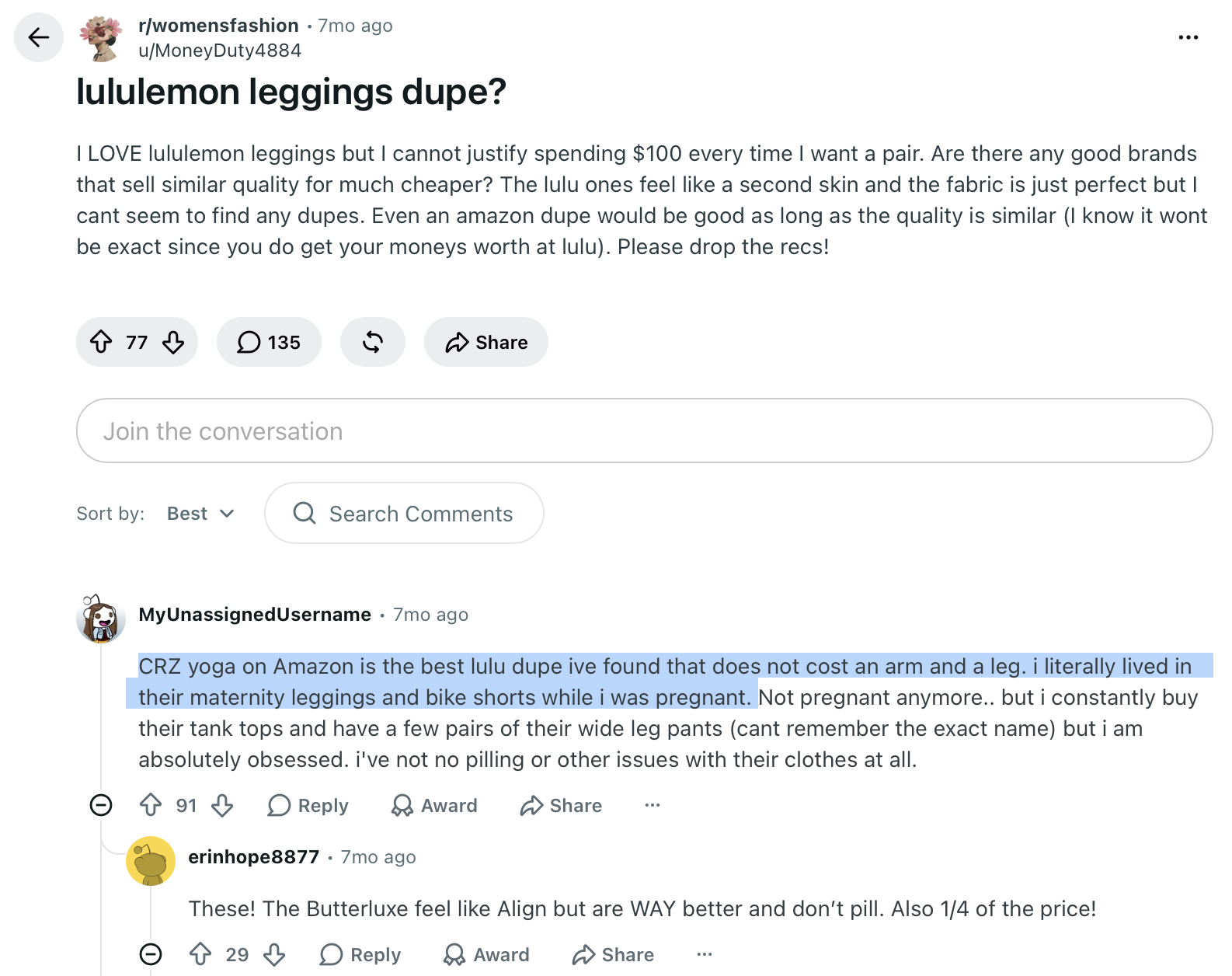
Reddit thread in r/womensfashion asking for cheaper alternatives to $100 Lululemon leggings, with shoppers recommending CRZ Yoga
Via Reddit

One discussion doesn't establish a broader switching trend, but it gives an insights team specific questions to investigate. Are shoppers leaving because of the price, or do they believe cheaper alternatives deliver similar quality? Which product features carry the most weight?

Here's how to turn that into an actionable research objective:

Start with a topic→ Set a clear objective→ Define the research scope
Weak objective: Monitor competitors in the activewear categoryBetter objective: Understand why shoppers recommend cheaper alternatives to premium yoga leggings, and which product benefits influence their decisions over the next 90 daysCategory: Yoga leggings
Audience: Premium activewear shoppers
Competitors: CRZ Yoga, Colorfulkoala, and other recommended alternatives
Geography: U.S. market
Timeframe: 90 days
Owner: Consumer insights team, working with product and marketing
Decision: Which product improvements or positioning changes should we test?

Step 2. Identify and prioritize the competitors worth tracking

Pepsi's most obvious competitor is Coca-Cola. When it comes to zero-sugar drinks, Pepsi Zero Sugar competes with Diet Coke and Coke Zero Sugar.

But in a Reddit discussion about soda alternatives, a regular Coke drinker wanted to cut back but disliked diet sodas. Other users recommended Olipop and Poppi, two smaller brands offering soda with less sugar than regular Coke and added prebiotic fiber.
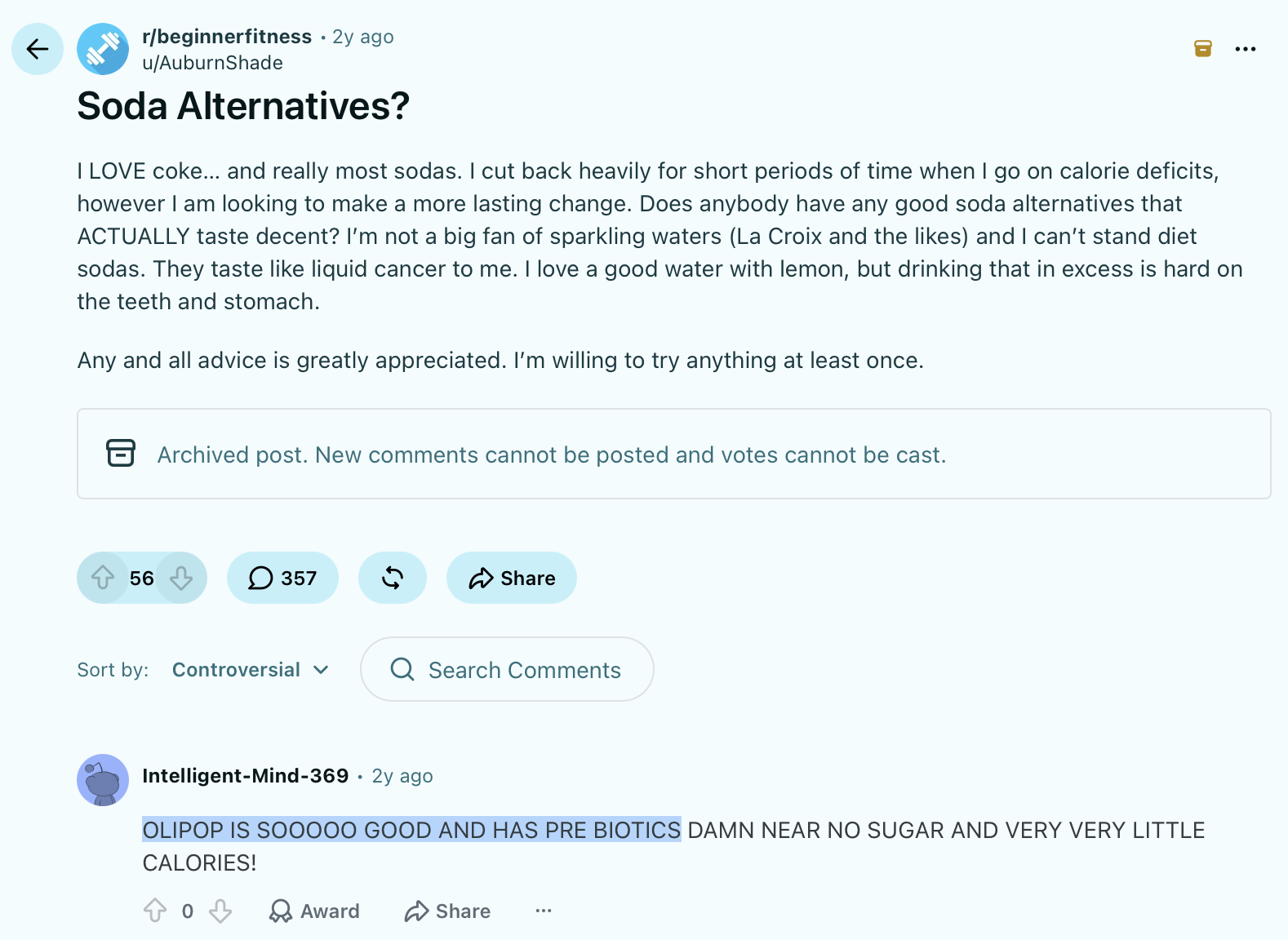
Reddit thread in r/beginnerfitness about soda alternatives, with commenters recommending Olipop over diet soda
Via Reddit

These brands have introduced benefits that traditional soda companies weren't historically competing on. PepsiCo's $1.95 billion acquisition of Poppi in 2025 shows how seriously established players are taking this segment.

NielsenIQ and Kearney's 2026 research found that established niche brands gained 1.5 percentage points of U.S. market share between 2022 and 2025, while large and midsize national brands lost 2.1 points across consumer product categories.

Your most obvious competitors may not be so evident when walking down a supermarket aisle.

That's why I recommend tracking 4 types of competitors:

  • Direct competitors offer similar products to the same audience, such as Pepsi and Coca-Cola
  • Indirect competitors satisfy the same consumer need through a different product, such as soda and flavored sparkling water
  • Emerging competitors are smaller brands gaining consumer attention or introducing new product benefits, such as Olipop and Poppi in the soda category
  • Private label brands are retailers' own brands, such as Walmart's Great Value or Target's up&up; they often compete directly with established products on price, making them important alternatives to track

Start with 5 to 8 competitors and prioritize them based on audience overlap, product similarity, price range, and evidence that shoppers are considering switching. Review your list quarterly as new alternatives emerge.

Step 3. Collect competitor activity and consumer response data

For every product you're tracking, capture the original source, date, product variant, price, and relevant consumer feedback. Compare equivalent pack sizes and the same time periods wherever possible.

And don't limit your research to competitors' websites and social accounts. Consumer organization Which? investigated 34 cosmetics bought from third-party sellers on Amazon, eBay, TikTok Shop, and Vinted. After comparing the products with genuine versions, researchers found that 23 out of 34 were likely counterfeit.

The issue also shows up in consumer conversations. In a Reddit post about CeraVe moisturizer, a shopper shared photos of a product they believed was counterfeit after purchasing through Amazon with third-party fulfillment.
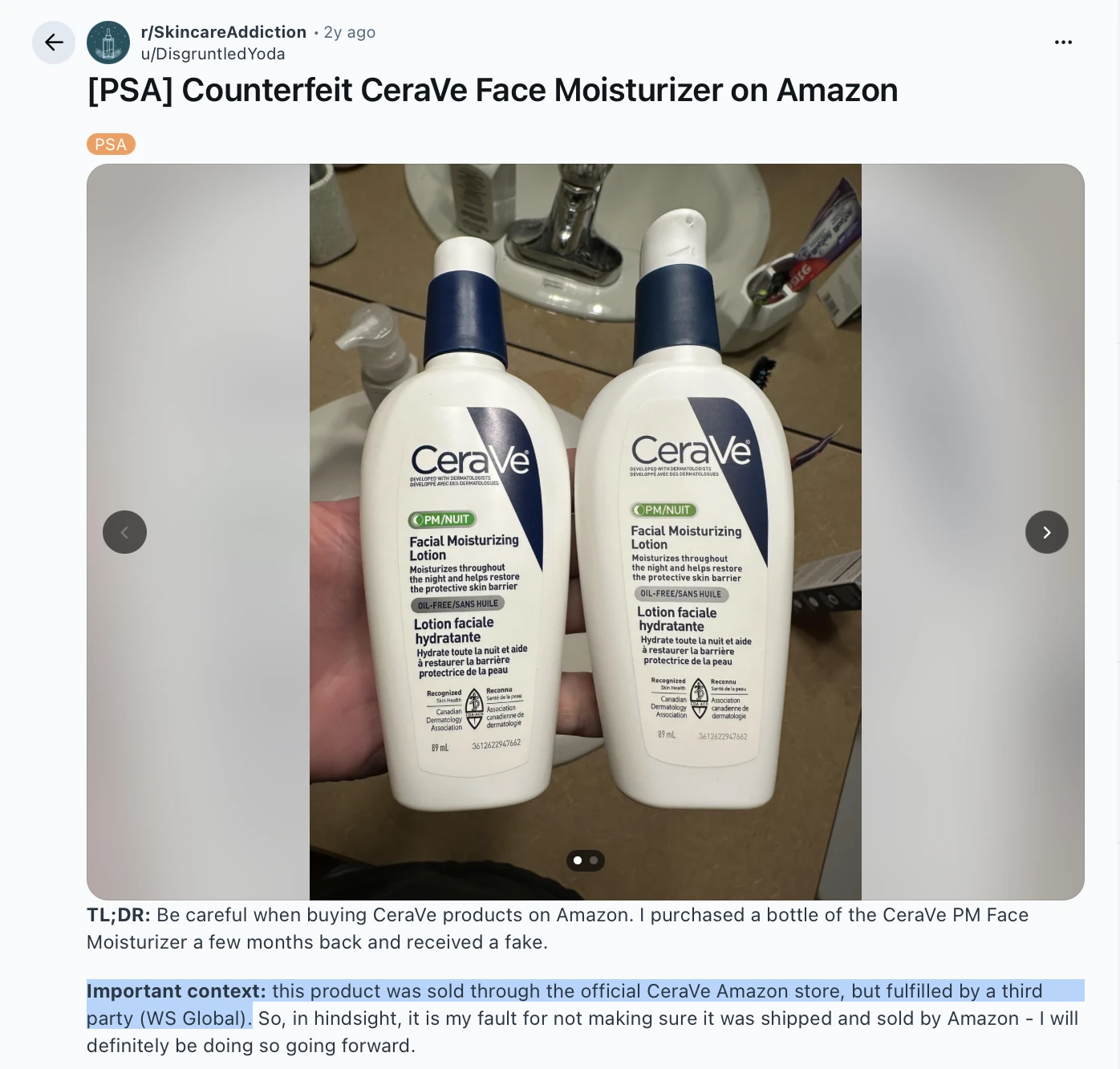
Reddit post in r/SkincareAddiction showing a suspected counterfeit CeraVe moisturizer bought through a third-party Amazon seller
Via Reddit

For a consumer brand, monitoring marketplace listings alongside reviews and discussions can reveal these problems before they spread further.

Video creates an even trickier blind spot because a product can be discussed without its brand ever being mentioned. For example, this YouTube Short by Clean Kitchen Nutrition, titled "Which milk do you buy?" displays milk cartons from different brands and ranks conventional, organic, grass-fed, low-temperature pasteurized, and raw milk from "worst" to "best."

The brands themselves aren't named in the narration or caption. But their cartons and logos are clearly visible, associating those products with the creator's comparisons.
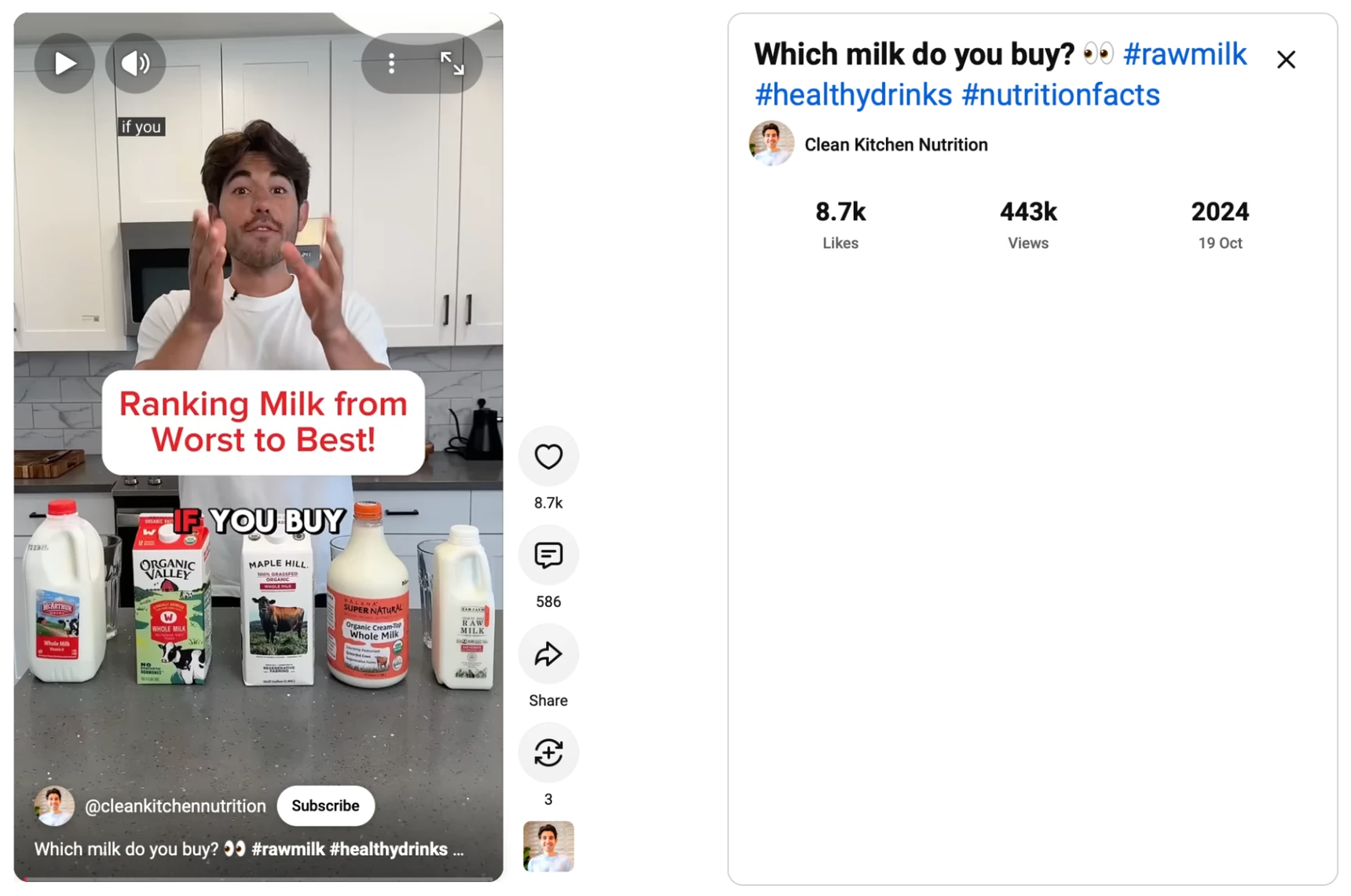
At 443,000 views, it is substantial exposure for a comparison those brands might never find through text-based mention tracking.

Clayface's social intelligence platform helps you find videos featuring your products, even when your brand isn't tagged or mentioned.

It also analyzes and summarizes what's being said, so you don't have to watch every video or read through transcripts yourself. As the dashboard image below shows, Clayface organizes videos by content type, topics, and products shown, with timestamped highlights that take you directly to the relevant moments.
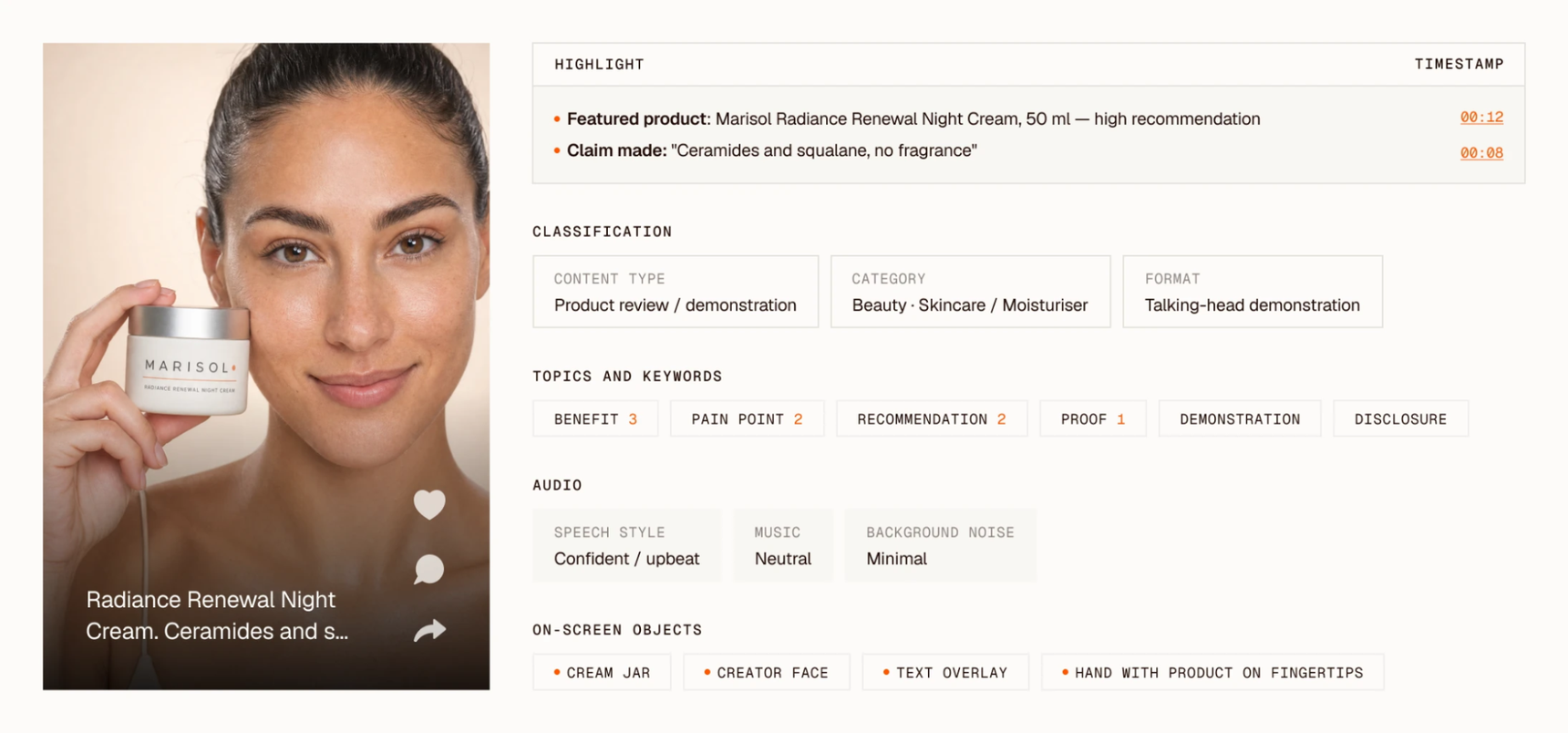
Clayface dashboard breaking a product video into timestamped highlights, spoken claims, topics and on-screen objects

Step 4. Compare the evidence to identify competitive gaps

Once you've collected the data, compare what each brand promises, what its products deliver, and what consumers actually say.

Start with questions such as:

  • Which product benefits are competitors claiming that customers genuinely value?
  • What complaints appear repeatedly in reviews and social conversations?
  • Are customers recommending cheaper alternatives for a particular reason?
  • Where does a brand's product promise differ from the experience customers report?

The last question became particularly relevant when Glossier reformulated its popular Balm Dotcom lip balm in 2023, introducing a vegan formula and an updated applicator.

While some customers welcomed the changes, others complained that the new formula felt less moisturizing or separated. In a January 2024 Reddit discussion, a longtime customer asked what to use instead, and other shoppers recommended brands such as Summer Fridays and Lanolips.
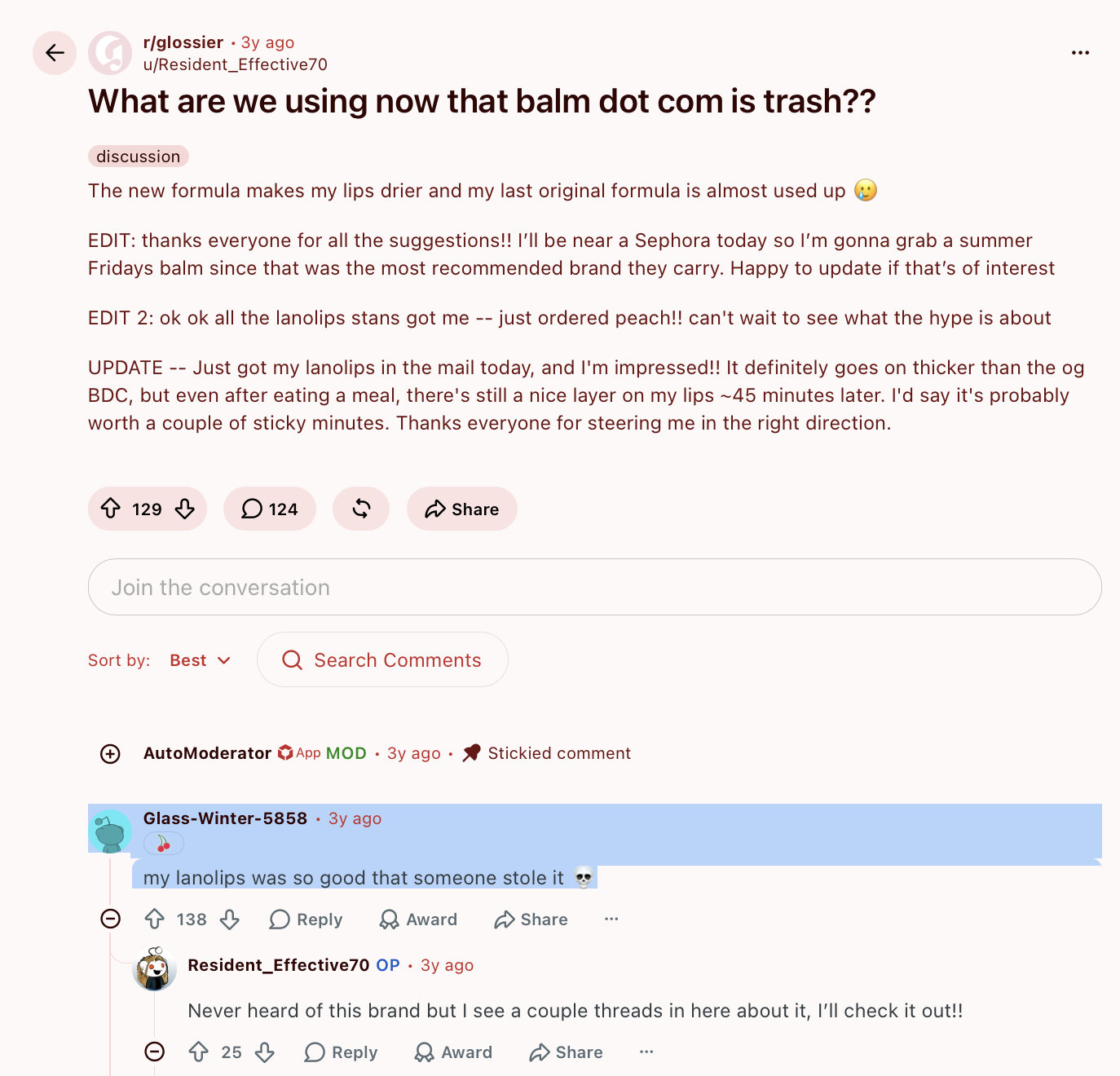
Reddit thread in r/glossier about the reformulated Balm Dotcom, with shoppers recommending Summer Fridays and Lanolips instead
Via Reddit

Comparing the product change with customer feedback made it clear that customers valued the original formula's texture and moisturizing performance enough to start considering alternatives.

After identifying these gaps, you still need to decide which findings deserve attention first. The Competitor Move × Consumer Response Matrix helps you compare the significance of a competitor's move with the strength of the consumer reaction:
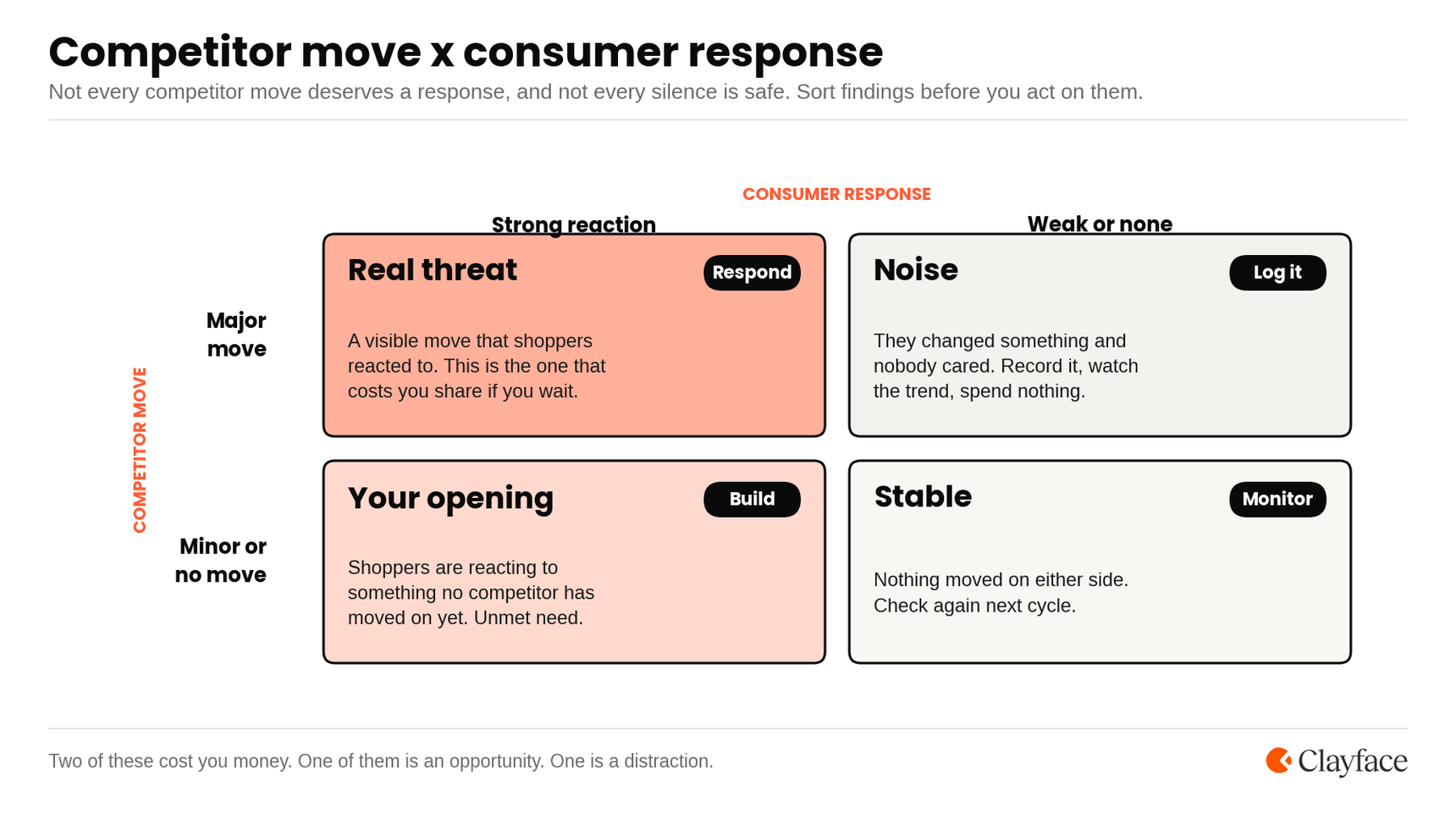
Matrix classifying competitive intelligence findings by competitor move size and strength of consumer response

Step 5. Turn your findings into decisions

Once you've identified a competitive gap, I recommend breaking each finding into three parts: Observation, Interpretation, and Action.

Let's continue with the Glossier example from Step 4.

  • Observation: Customers complained about Balm Dotcom's new texture and moisturizing performance, while some Reddit users started looking for alternatives
  • Interpretation: The reformulation had changed something existing customers valued, giving competing brands an opportunity
  • Action: Address those complaints by restoring the qualities customers missed. Glossier did this in May 2024, bringing back the original formula while keeping the newer applicator
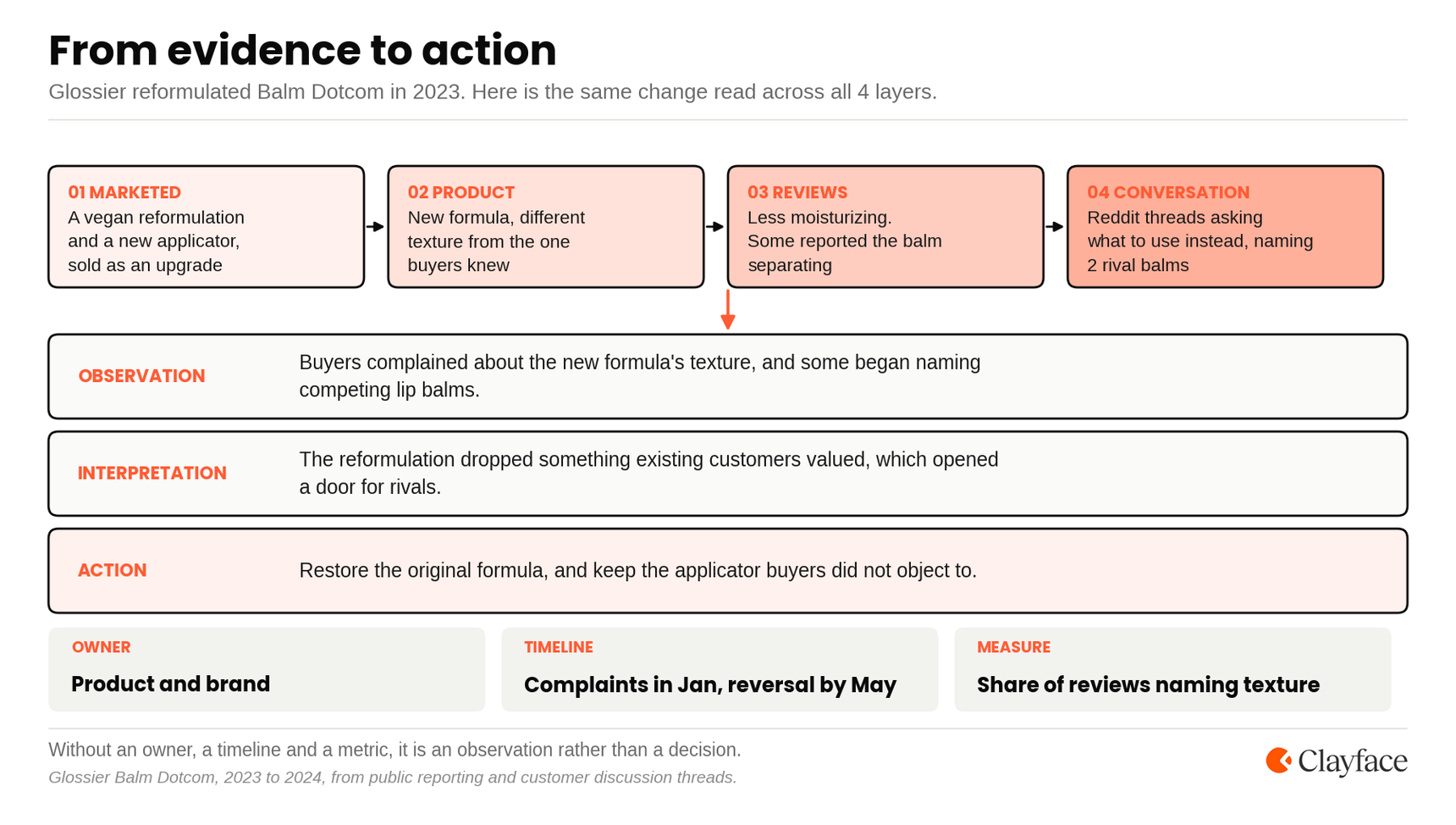
The Glossier Balm Dotcom reformulation read across 4 layers and turned into an action with an owner, timeline and measure
Glossier Balm Dotcom reformulation read across 4 layers and turned into an action with an owner, timeline and measure

But not every finding calls for a product change. Remember the leggings discussion from Step 1, where shoppers recommended a $30 alternative to a $100 pair?

  • Observation: Shoppers recommended cheaper leggings, with some describing the fabric as comparable to premium alternatives
  • Interpretation: Price isn't necessarily the only issue. Shoppers are questioning what makes the premium pair worth an additional $70
  • Action: Test whether promotional pricing improves conversion, or whether emphasizing differences in durability, fit, and construction gives shoppers a stronger reason to pay more

For your own brand, each recommendation should have an owner, a deadline, and a way to measure whether it worked.

And this is often where things get complicated. Social teams see the complaints, ecommerce tracks reviews, finance watches sales, and category managers monitor market share. They're all looking at the same business from different angles, but the findings aren't always brought together.

Your framework should help the relevant team understand what needs attention and whether the response improves customer experience.

Step 6. Monitor changes and update your framework regularly

Competitor activity and consumer expectations keep changing, so the framework needs a regular review process. I recommend the following schedule as a starting point:

FrequencyWhat to review
WeeklyNew complaints, product launches, competitor activity, and unusual changes in conversation
MonthlyCompetitive findings, recommendations, and progress against assigned actions
QuarterlyCompetitor watchlist, product benchmarks, and whether the framework is answering the right questions
As significant changes occurAlerts for price changes, emerging complaints, or sudden increases in competitor attention

Track how quickly your team moves from identifying a signal to making a decision. For example, if you change your packaging after repeated complaints about a leaking bottle, monitor whether those complaints become less frequent relative to the total reviews collected.

How to automate your competitive intelligence framework with Clayface

You can update the tracker every week but as you add more items, comparing all that information manually becomes a lot of work.

Instead of checking multiple platforms every week, Clayface continuously monitors your products and competitors, bringing new mentions, consumer feedback, and changes in sentiment into one dashboard.

As you can see below, you can track how conversations about a particular SKU change over time, including mentions discovered inside videos where the brand might not be tagged. Each mention is linked to its source, so your team can investigate without searching through platforms manually.
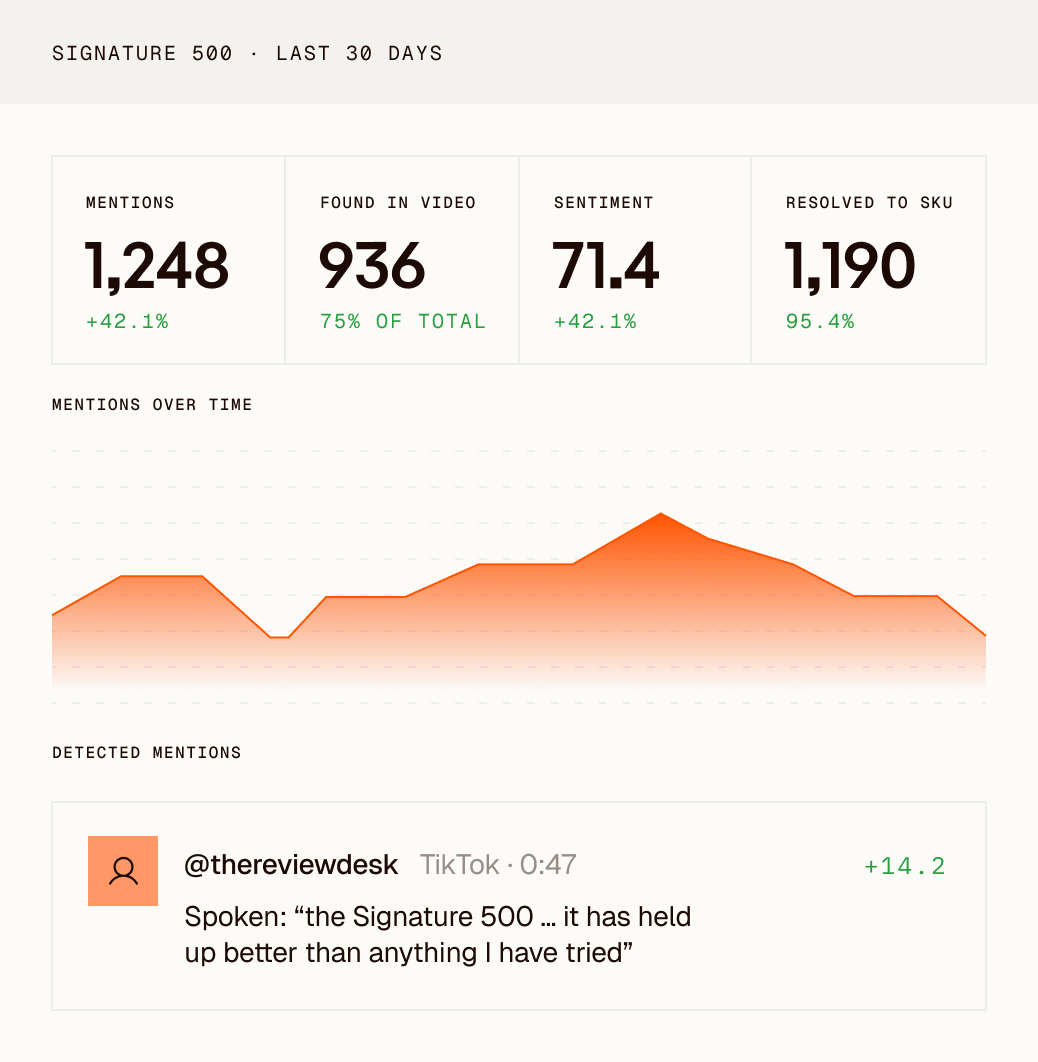
Clayface dashboard tracking mentions, video mentions, sentiment and SKU resolution for a single product over 30 days

You also get to know what people are talking about. Clayface groups conversations by themes, products, and sources, showing which topics are gaining momentum and which are losing attention.
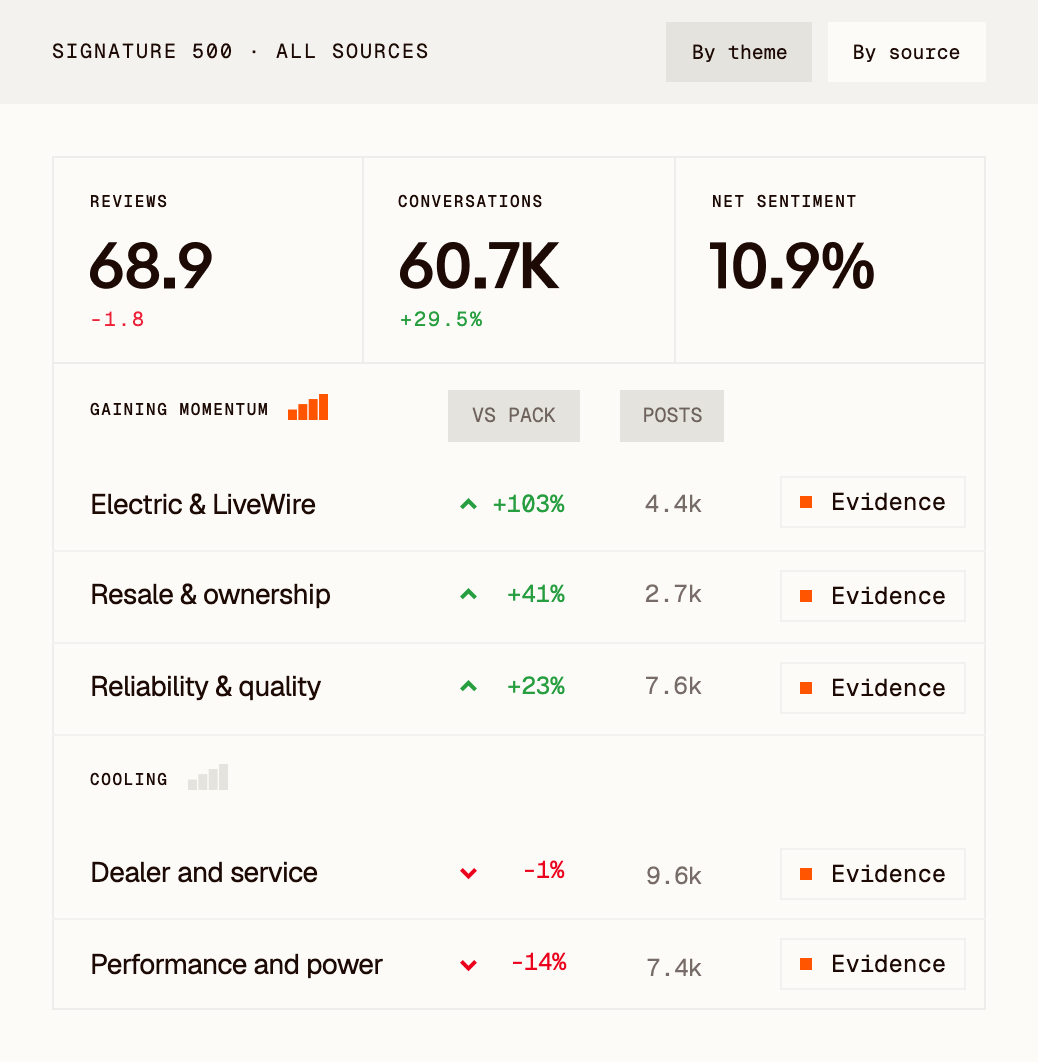
Clayface dashboard grouping product conversations by theme, showing which topics are gaining momentum and which are cooling

For example, you can see whether customers are increasingly discussing product reliability, resale value, or service issues.

You can also open the posts behind each finding to understand what consumers actually said and share that evidence with your team.

If you're already using another social listening tool, you don't have to switch right away. Run Clayface alongside your existing tool for 14 days for free and compare the results.

A Competitive Intelligence Framework for Consumer Brand Teams

Build a competitive intelligence framework in 6 steps with a free tracker. See how Clayface automates competitor monitoring, social listening, and product insights.

Ross Bose
Ross Bose
November 23, 2026
Published:
November 23, 2026
Updated:
A Competitive Intelligence Framework for Consumer Brand Teams

Summarize this article with AI

Table of Contents

TL;DR

  • A competitive intelligence framework connects competitor activity with consumer behavior. For consumer brands, this means tracking individual products, pricing, positioning, and customer reactions to understand what deserves a response.
  • No single framework covers everything. The 3Cs and 6Ps help assess competitors, while Jobs to Be Done explains consumer needs. P&G's Dawn Powerwash and Fairy Skip the Soak show why those needs can differ across markets.
  • Your biggest competitors aren't always the most obvious ones. Shoppers considering alternatives to traditional soda also recommend Olipop and Poppi. PepsiCo's $1.95 billion acquisition of Poppi shows why emerging challengers deserve attention.
  • Compare what brands promise with what customers actually experience. Product claims, specifications, reviews, and online conversations can reveal different things. Glossier's Balm Dotcom reformulation and subsequent reversal show why listening to customers matters.
  • Competitive intelligence works best as an ongoing process. Use the free six-step tracker to organize findings and assign actions. Clayface helps automate product-level monitoring, uncover untagged video mentions, and identify conversations gaining momentum.

A competitive intelligence framework helps consumer brands keep track of what competitors are doing and how shoppers respond including tracking changes in products, pricing, packaging, and retail availability with consumer feedback about each SKU.

But for many brands, competitor analysis is still a bi-annual (sometimes even annual) event. By then, a competitor can cut prices, a product can go viral, or shoppers can already be recommending cheaper alternatives on Reddit.

So, how does one turn this exhausting, daunting task to a weekly habit? Look at how e.l.f. Cosmetics approaches competition. When a prestige primer became a bestseller at $52, e.l.f. saw an opportunity to offer something similar at a fraction of the price, which went on to sell over 9x as many units as the original in a later 12-month comparison.

e.l.f. has a name for this broader strategy: “first-to-mass.” In its SEC filings, the company describes bringing trends from prestige beauty to the mass market, offering shoppers similar benefits at more accessible prices.

The cosmetics brand also pays close attention to what its customers want. The brand reads comments under its social posts, takes requests during TikTok and Instagram lives, and uses that feedback to develop new products.

If I had to classify e.l.f.'s approach, I'd say it combines four things:

  • Competitive benchmarking: Studying successful competitor products to identify what shoppers are already buying and where there's room to offer something different
  • Social listening: Following customer conversations to understand what people like, dislike, and wish brands would make
  • Consumer feedback loop: Bringing those requests into product development rather than leaving them in the comments
  • Jobs to Be Done thinking: Looking beyond the product itself to understand what shoppers want to accomplish; in this case, getting a smooth base for their makeup without paying prestige prices

Notice how these activities feed into each other? That’s how competitors become part of your daily reality. Here's how this continuous competitive intelligence cycle works:

Seven-step continuous competitive intelligence cycle showing how e.l.f. Beauty turns competitor launches into new products

In this guide, I’ll explore the different competitive intelligence frameworks consumer brands use, where each works best, and how to build one that fits your own brand.

5 competitive intelligence frameworks consumer brands use

There are several frameworks you can use to analyze competitors.

Say a competitor cuts the price of its bestselling shampoo from $12 to $9. The 6Ps framework can help you compare the new offer, while Jobs to Be Done can help you understand whether the lower price is enough to make customers switch.

What I'm going to help you focus on is finding your framework and building a repeatable process. Let's start with five established approaches worth understanding:

FrameworkWhat it helps consumer brands doExampleWhat you still need to add
3Cs FrameworkFind a competitive advantage by examining customers, competitors, and your company's capabilities togetherA dairy brand sees demand for protein-rich snacks, rivals focusing on bars, and an opportunity to use its yogurt expertiseRegular product and consumer monitoring
4Ps / 6Ps FrameworkEvaluate how a product competes through its offering, pricing, distribution, packaging, positioning, and promotionsA sunscreen brand compares a rival's SPF, price, packaging, retail placement, and advertising before planning its launchEvidence of how shoppers respond to those choices
SWOT AnalysisSeparate internal strengths and weaknesses from external opportunities and threatsA cereal brand maps strong customer loyalty as a strength, high costs as a weakness, protein demand as an opportunity, and private labels as a threatFresh evidence to keep the assessment current
Jobs to Be Done (JTBD)Understand the underlying task consumers want to accomplish, including why they might choose a different product categoryA parent buying frozen meals wants dinner ready in 10 minutes. Meal kits, takeout, and frozen food all compete for that jobMonitoring of brands addressing those needs
Competitive Intelligence CycleTurn competitor research into a repeatable process of collection, analysis, sharing, action, and reviewA team detects a rival's launch, analyzes customer reactions, briefs product managers, tests a response, and reviews the resultsDefined data sources, monitoring frequency, and team responsibilities

Let me show you how 2 consumer brands have combined and applied these competitive intelligence frameworks to actual products.

1. How Unilever uses the 6Ps to improve product competitiveness

Unilever's Unmissable Brand Superiority framework evaluates products across six factors: Product, Price, Place, Proposition, Promotion, and Pack. Dove's Serum Shower Collection, launched in North America in 2024, is a useful example of how these factors can work together.

Mintel's research found that 92% of surveyed US body wash users considered caring for their body skin as important as facial skincare.

Dove responded with body washes containing familiar facial skincare ingredients such as hyaluronic acid, salicylic acid, and vitamin C. But the approach went beyond formulation. Dove also introduced premium packaging, positioned the collection as accessible premium body care, and brought it to mass retail channels.

Here's how the launch fits the 6Ps framework:

The 6Ps framework applied to Dove’s Serum Shower Collection across product, price, place, proposition, promotion and pack

The 6Ps helps brands evaluate how well their product, pricing, positioning, and distribution work together. But consumer research is what helps establish which benefits shoppers actually want.

2. How P&G used Jobs to Be Done to rethink dish soap

Jobs to Be Done focuses on what consumers are trying to accomplish rather than the products they're using.

Traditional dish soap was designed for a familiar routine of filling the sink, washing the dishes, and rinsing them afterward. But P&G's research found that 61% of Americans were cleaning dishes as they cooked instead of letting them pile up.

This gave P&G a different problem to solve. People wanted to wash a plate or pan while cooking, without filling the sink or waiting for stubborn grease to soak. After five years of development, the brand launched Dawn Powerwash, a spray-on cleaner designed for exactly that routine.

This is what makes Jobs to Be Done useful. Rather than improving the existing dish soap formula alone, P&G looked at how people's cleaning habits had changed and developed a product around them.

Find out what shoppers in each market are asking for

Clayface tracks conversations across Reddit, TikTok, and other platforms, organizing them by region, product, and recurring requests. See where customer preferences differ before the next launch.

Request a demo

How to build a competitive intelligence framework for consumer brands in 6 steps

I recommend a Consumer Response Framework that extracts the most useful elements of the 3Cs, 6Ps, Jobs to Be Done, and the continuous intelligence cycle and combines them.

But for consumer brands, I recommend taking this one step further by examining every important product or SKU, both yours and your competitors', through 4 layers:

  1. Marketed: What the brand promises through its product pages, packaging, and advertising
  2. Product: What the product actually offers, including its formulation, specifications, size, and price
  3. Reviews: What customers say after purchasing and using the product
  4. Conversations: What people discuss, compare, recommend, or complain about across social media and online communities

For example, a competitor might advertise a long-lasting foundation, but customers repeatedly complain that it oxidizes after a few hours. That's a product weakness your brand could address.

Here's how the four layers work together:

Concentric diagram of the 4 layers of a consumer competitive intelligence framework: marketed, product, reviews and conversation
4 layers of a consumer competitive intelligence framework: marketed, product, reviews and conversation

Now, let's look at how to build and implement this competitive intelligence framework in six steps.

A competitive intelligence tracker you can copy

Before you start reading deeper, I've put together a free editable consumer response tracker you can use to apply the six-step competitive intelligence framework to your own brand.

There's a filled-in example to show you how it works. Start with one product, add the competitors your customers are considering, and build from there.

You can update it weekly as new conversations emerge and share it with your team.

Step 1. Define what you want your competitive intelligence to achieve

Before you start collecting competitor data, decide what business question you're trying to answer.

A clear objective gives teams something specific to work toward. Look at this Reddit discussion about Lululemon leggings, where a shopper wanted a cheaper alternative to leggings costing around $100. Other shoppers recommended brands like CRZ Yoga, comparing fabric softness, fit, durability, and price.

Reddit thread in r/womensfashion asking for cheaper alternatives to $100 Lululemon leggings, with shoppers recommending CRZ Yoga
Via Reddit

One discussion doesn't establish a broader switching trend, but it gives an insights team specific questions to investigate. Are shoppers leaving because of the price, or do they believe cheaper alternatives deliver similar quality? Which product features carry the most weight?

Here's how to turn that into an actionable research objective:

Start with a topic→ Set a clear objective→ Define the research scope
Weak objective: Monitor competitors in the activewear categoryBetter objective: Understand why shoppers recommend cheaper alternatives to premium yoga leggings, and which product benefits influence their decisions over the next 90 daysCategory: Yoga leggings
Audience: Premium activewear shoppers
Competitors: CRZ Yoga, Colorfulkoala, and other recommended alternatives
Geography: U.S. market
Timeframe: 90 days
Owner: Consumer insights team, working with product and marketing
Decision: Which product improvements or positioning changes should we test?

Step 2. Identify and prioritize the competitors worth tracking

Pepsi's most obvious competitor is Coca-Cola. When it comes to zero-sugar drinks, Pepsi Zero Sugar competes with Diet Coke and Coke Zero Sugar.

But in a Reddit discussion about soda alternatives, a regular Coke drinker wanted to cut back but disliked diet sodas. Other users recommended Olipop and Poppi, two smaller brands offering soda with less sugar than regular Coke and added prebiotic fiber.

Reddit thread in r/beginnerfitness about soda alternatives, with commenters recommending Olipop over diet soda
Via Reddit

These brands have introduced benefits that traditional soda companies weren't historically competing on. PepsiCo's $1.95 billion acquisition of Poppi in 2025 shows how seriously established players are taking this segment.

NielsenIQ and Kearney's 2026 research found that established niche brands gained 1.5 percentage points of U.S. market share between 2022 and 2025, while large and midsize national brands lost 2.1 points across consumer product categories.

Your most obvious competitors may not be so evident when walking down a supermarket aisle.

That's why I recommend tracking 4 types of competitors:

  • Direct competitors offer similar products to the same audience, such as Pepsi and Coca-Cola
  • Indirect competitors satisfy the same consumer need through a different product, such as soda and flavored sparkling water
  • Emerging competitors are smaller brands gaining consumer attention or introducing new product benefits, such as Olipop and Poppi in the soda category
  • Private label brands are retailers' own brands, such as Walmart's Great Value or Target's up&up; they often compete directly with established products on price, making them important alternatives to track

Start with 5 to 8 competitors and prioritize them based on audience overlap, product similarity, price range, and evidence that shoppers are considering switching. Review your list quarterly as new alternatives emerge.

Step 3. Collect competitor activity and consumer response data

For every product you're tracking, capture the original source, date, product variant, price, and relevant consumer feedback. Compare equivalent pack sizes and the same time periods wherever possible.

And don't limit your research to competitors' websites and social accounts. Consumer organization Which? investigated 34 cosmetics bought from third-party sellers on Amazon, eBay, TikTok Shop, and Vinted. After comparing the products with genuine versions, researchers found that 23 out of 34 were likely counterfeit.

The issue also shows up in consumer conversations. In a Reddit post about CeraVe moisturizer, a shopper shared photos of a product they believed was counterfeit after purchasing through Amazon with third-party fulfillment.

Reddit post in r/SkincareAddiction showing a suspected counterfeit CeraVe moisturizer bought through a third-party Amazon seller
Via Reddit

For a consumer brand, monitoring marketplace listings alongside reviews and discussions can reveal these problems before they spread further.

Video creates an even trickier blind spot because a product can be discussed without its brand ever being mentioned. For example, this YouTube Short by Clean Kitchen Nutrition, titled "Which milk do you buy?" displays milk cartons from different brands and ranks conventional, organic, grass-fed, low-temperature pasteurized, and raw milk from "worst" to "best."

The brands themselves aren't named in the narration or caption. But their cartons and logos are clearly visible, associating those products with the creator's comparisons.

At 443,000 views, it is substantial exposure for a comparison those brands might never find through text-based mention tracking.

Clayface's social intelligence platform helps you find videos featuring your products, even when your brand isn't tagged or mentioned.

It also analyzes and summarizes what's being said, so you don't have to watch every video or read through transcripts yourself. As the dashboard image below shows, Clayface organizes videos by content type, topics, and products shown, with timestamped highlights that take you directly to the relevant moments.

Clayface dashboard breaking a product video into timestamped highlights, spoken claims, topics and on-screen objects

Step 4. Compare the evidence to identify competitive gaps

Once you've collected the data, compare what each brand promises, what its products deliver, and what consumers actually say.

Start with questions such as:

  • Which product benefits are competitors claiming that customers genuinely value?
  • What complaints appear repeatedly in reviews and social conversations?
  • Are customers recommending cheaper alternatives for a particular reason?
  • Where does a brand's product promise differ from the experience customers report?

The last question became particularly relevant when Glossier reformulated its popular Balm Dotcom lip balm in 2023, introducing a vegan formula and an updated applicator.

While some customers welcomed the changes, others complained that the new formula felt less moisturizing or separated. In a January 2024 Reddit discussion, a longtime customer asked what to use instead, and other shoppers recommended brands such as Summer Fridays and Lanolips.

Reddit thread in r/glossier about the reformulated Balm Dotcom, with shoppers recommending Summer Fridays and Lanolips instead
Via Reddit

Comparing the product change with customer feedback made it clear that customers valued the original formula's texture and moisturizing performance enough to start considering alternatives.

After identifying these gaps, you still need to decide which findings deserve attention first. The Competitor Move × Consumer Response Matrix helps you compare the significance of a competitor's move with the strength of the consumer reaction:

Matrix classifying competitive intelligence findings by competitor move size and strength of consumer response

Step 5. Turn your findings into decisions

Once you've identified a competitive gap, I recommend breaking each finding into three parts: Observation, Interpretation, and Action.

Let's continue with the Glossier example from Step 4.

  • Observation: Customers complained about Balm Dotcom's new texture and moisturizing performance, while some Reddit users started looking for alternatives
  • Interpretation: The reformulation had changed something existing customers valued, giving competing brands an opportunity
  • Action: Address those complaints by restoring the qualities customers missed. Glossier did this in May 2024, bringing back the original formula while keeping the newer applicator
The Glossier Balm Dotcom reformulation read across 4 layers and turned into an action with an owner, timeline and measure
Glossier Balm Dotcom reformulation read across 4 layers and turned into an action with an owner, timeline and measure

But not every finding calls for a product change. Remember the leggings discussion from Step 1, where shoppers recommended a $30 alternative to a $100 pair?

  • Observation: Shoppers recommended cheaper leggings, with some describing the fabric as comparable to premium alternatives
  • Interpretation: Price isn't necessarily the only issue. Shoppers are questioning what makes the premium pair worth an additional $70
  • Action: Test whether promotional pricing improves conversion, or whether emphasizing differences in durability, fit, and construction gives shoppers a stronger reason to pay more

For your own brand, each recommendation should have an owner, a deadline, and a way to measure whether it worked.

And this is often where things get complicated. Social teams see the complaints, ecommerce tracks reviews, finance watches sales, and category managers monitor market share. They're all looking at the same business from different angles, but the findings aren't always brought together.

Your framework should help the relevant team understand what needs attention and whether the response improves customer experience.

Step 6. Monitor changes and update your framework regularly

Competitor activity and consumer expectations keep changing, so the framework needs a regular review process. I recommend the following schedule as a starting point:

FrequencyWhat to review
WeeklyNew complaints, product launches, competitor activity, and unusual changes in conversation
MonthlyCompetitive findings, recommendations, and progress against assigned actions
QuarterlyCompetitor watchlist, product benchmarks, and whether the framework is answering the right questions
As significant changes occurAlerts for price changes, emerging complaints, or sudden increases in competitor attention

Track how quickly your team moves from identifying a signal to making a decision. For example, if you change your packaging after repeated complaints about a leaking bottle, monitor whether those complaints become less frequent relative to the total reviews collected.

How to automate your competitive intelligence framework with Clayface

You can update the tracker every week but as you add more items, comparing all that information manually becomes a lot of work.

Instead of checking multiple platforms every week, Clayface continuously monitors your products and competitors, bringing new mentions, consumer feedback, and changes in sentiment into one dashboard.

As you can see below, you can track how conversations about a particular SKU change over time, including mentions discovered inside videos where the brand might not be tagged. Each mention is linked to its source, so your team can investigate without searching through platforms manually.

Clayface dashboard tracking mentions, video mentions, sentiment and SKU resolution for a single product over 30 days

You also get to know what people are talking about. Clayface groups conversations by themes, products, and sources, showing which topics are gaining momentum and which are losing attention.

Clayface dashboard grouping product conversations by theme, showing which topics are gaining momentum and which are cooling

For example, you can see whether customers are increasingly discussing product reliability, resale value, or service issues.

You can also open the posts behind each finding to understand what consumers actually said and share that evidence with your team.

If you're already using another social listening tool, you don't have to switch right away. Run Clayface alongside your existing tool for 14 days for free and compare the results.

Frequently asked questions

Is competitive intelligence legal for consumer brands?

Yes, as long as you collect information legally and ethically. Public reviews, social posts, product pages, and competitor ads are common sources. Avoid accessing private information or misrepresenting yourself to obtain confidential data. If you're collecting personal data, make sure you comply with applicable privacy laws, including GDPR and CCPA where relevant.

Who should own competitive intelligence in a consumer brand?

Usually, the consumer insights team manages the research and analysis. Brand and category managers decide what to do with the findings, while product, ecommerce, or marketing teams implement the changes. The important thing is to assign an owner to every recommendation.

How is competitive intelligence different from syndicated market data?

Syndicated data shows what sold, at what price, and through which retailers. Competitive intelligence helps you understand what competitors are changing and how consumers are responding. Used together, they help you identify possible reasons behind sales trends and decide what to investigate next.

Can social listening replace brand tracking studies?

Not entirely. Brand tracking studies can measure awareness, perception, and purchase intent across a representative audience. Social listening captures unsolicited opinions from people actively discussing products online. Use it to uncover complaints, emerging needs, and switching behavior, then validate broader patterns through research.

How often should consumer brands update their competitive intelligence framework?

Review new consumer conversations and competitor activity weekly, assess findings and actions monthly, and update your competitor watchlist quarterly. Set alerts for major launches, price changes, and emerging complaints so you can respond without waiting for the next scheduled review.