How to Find Customer Pain Points in Unprompted Online Conversations
Small cream and peach paper speech bubbles around a larger orange paper speech bubble with a white exclamation mark

By the late 1990s, the internet had become a major platform for customer feedback, with conversations shifting to review sites and marketplace star ratings.

But it would be foolish to assume that honest customer insights are only collected through surveys or feedback forms. They're also found in unprompted conversations happening across social media, forums, and comment sections.

And brands that pay attention are already acting on them. In 2022, two TikTok creators popularized a menu hack involving a steak quesadilla with fajita vegetables and a custom sauce made from Chipotle's vinaigrette and sour cream. After the trend generated over 30 million views, Chipotle officially introduced the Fajita Quesadilla in March 2023, turning a customer-created combination into a menu item.

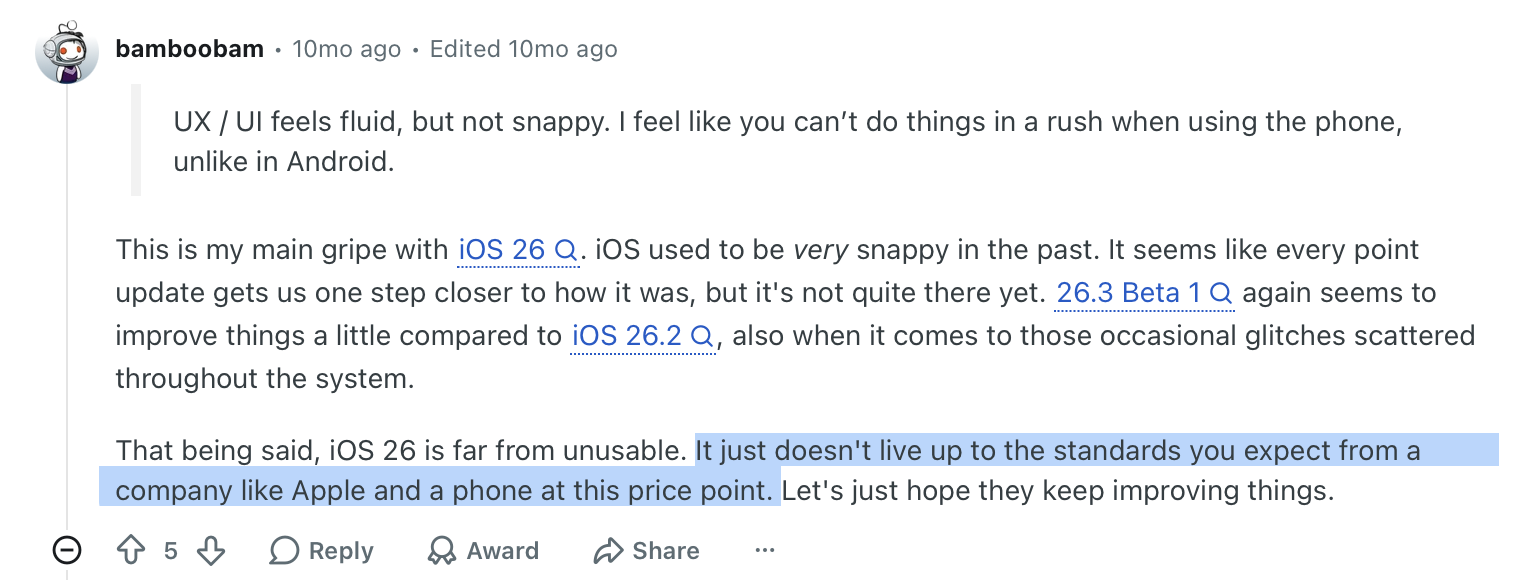
But what do these unprompted conversations actually look like? Here's a great example from Reddit.
Reddit comment on an iPhone 17 thread saying iOS used to feel snappier than it does now, unprompted customer pain point via social listening
Via Reddit

This is from a longtime Android user sharing their experience after using the iPhone 17 for a month.

While the post itself contains plenty of useful information, the comments get specific very quickly. One user points out that iOS used to feel much snappier and that every new update brings it a little closer to how it was, but it's still not quite there.

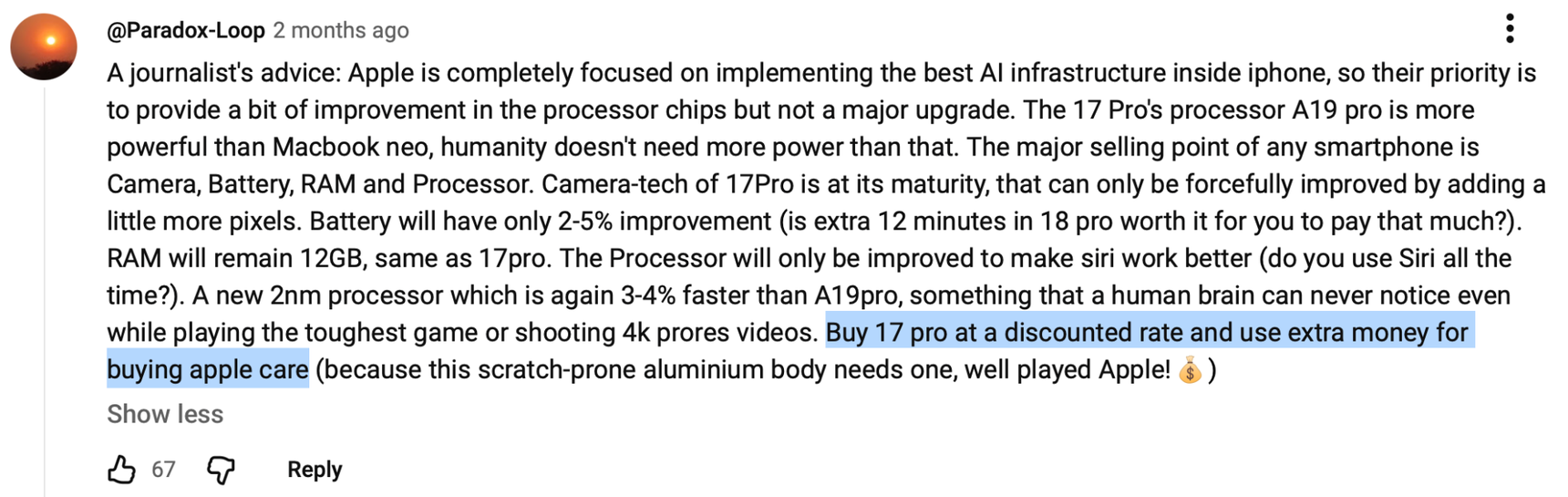
Here's another example from a YouTube review of the same phone, with over 300 comments underneath.
YouTube comment under an iPhone 17 review recommending the older model over the new one, unprompted customer pain point via social listening
Via YouTube

One of the top comments breaks down the phone's shortcomings and recommends buying the older model instead. The conversation continues - other users jump in, share their perspectives, and continue discussing the trade-offs.

My point is that these are the places where people talk about products after actually living with them for weeks or even months. Their feedback is often incredibly specific, and it's not just complaints. Sometimes, people talk about features they miss from older models and wish the company would bring back, or new improvements they'd like to see in the next release.

Many brands don't systematically monitor these interactions, but learning how to find customer pain points in them opens up product research, pricing research, and even messaging research, all served up on a silver platter.

What an unprompted customer pain point is and why brands should care

Prompted feedback is usually designed by the brand. Customers answer questions or choose from options that are already framed in the brand's own words.

But what exactly qualifies as an unprompted customer pain point? It's a problem that a customer describes publicly without anyone asking them to. The easiest way to remember the difference is that unprompted feedback is always volunteered.

And the biggest reason brands should care about this kind of feedback is that 97% of shoppers consult multiple sources before making a purchase.

Before buying a new gadget, most of us probably watch a bunch of YouTube reviews, browse Reddit threads, and ask friends or family for their opinions. I have friends who go down this research rabbit hole simply before trying a new gluten-free bread.

At Clayface, we're seeing a direct correlation between negative comments, posts, and videos and a decline in products sold through digital shelves. And I can relate to that as a consumer. I even find myself second-guessing a purchase when I come across a convincing negative review from another customer.

Here's an easy table comparing prompted and unprompted feedback.

PromptedUnprompted
Who you hear fromA small, self-selected slice. Ecommerce email surveys average a 3.24% response rate across more than 25 million invitationsAnyone who felt strongly enough to post. 1 in 3 use Reddit specifically for pre-purchase research
BiasThe question sets the frame and people soften the answer. Short surveys of 2 to 3 questions get a 15.97% median responseNobody is watching, so the wording is honest and often unflattering
RecencyTied to your survey calendar, usually monthly or quarterlyContinuous, complaints appear within days of the problem
Level of feedback detailYou only learn what you think to ask. Most answers are a score plus one line of free textSpecific. Model, batch, retailer, what they switched to, what they want next
CostPanel fees, incentives, and research timeFree to read, expensive to find at scale

What unprompted conversation gives you that surveys cannot

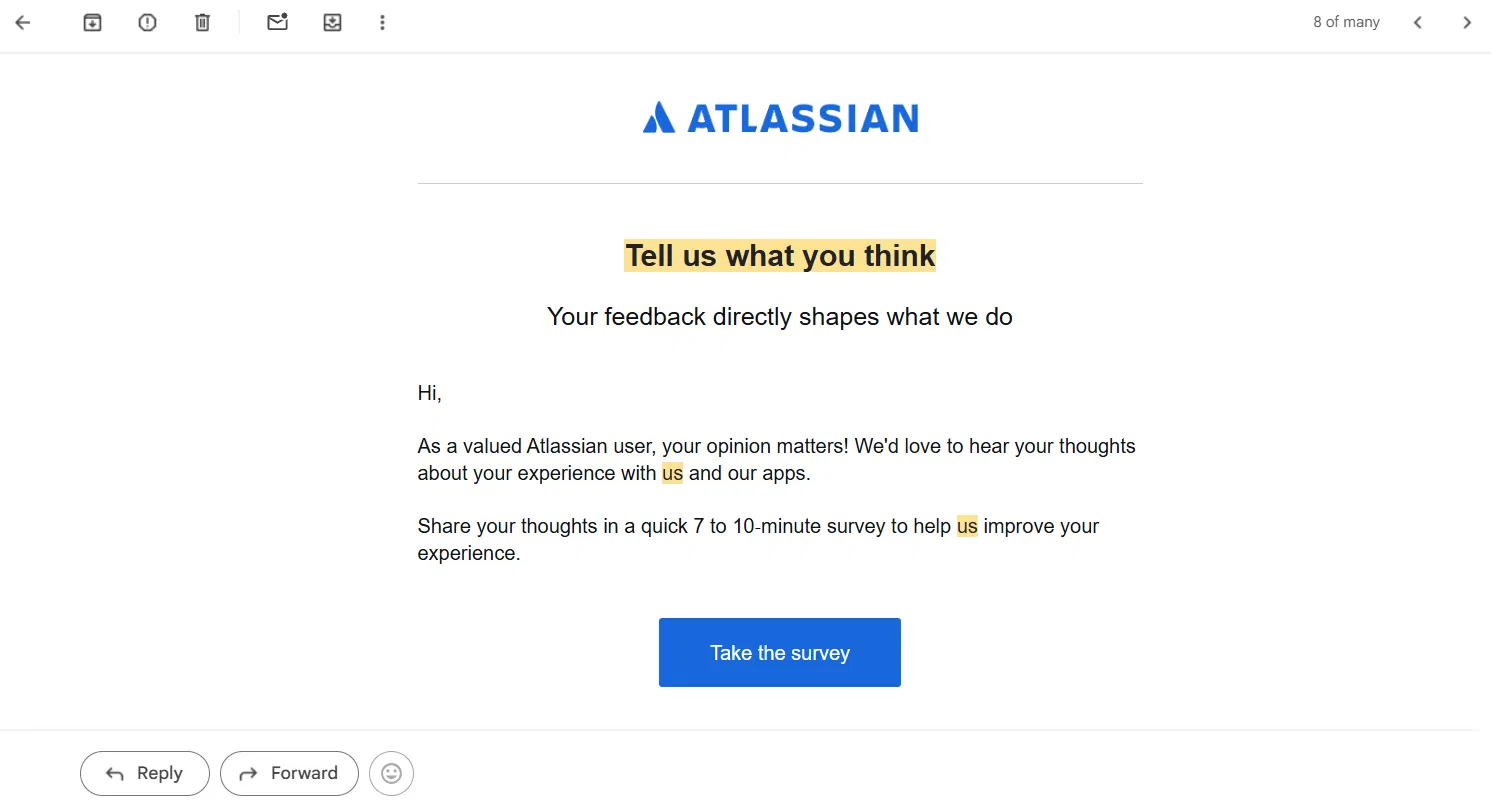
Here's an email I received from Atlassian asking for feedback.
Atlassian email asking users to take a feedback survey

And here's what opens when you click through. A 10-minute survey that starts with a 7-point satisfaction scale. The only field where you can actually describe a problem in your own words is optional.
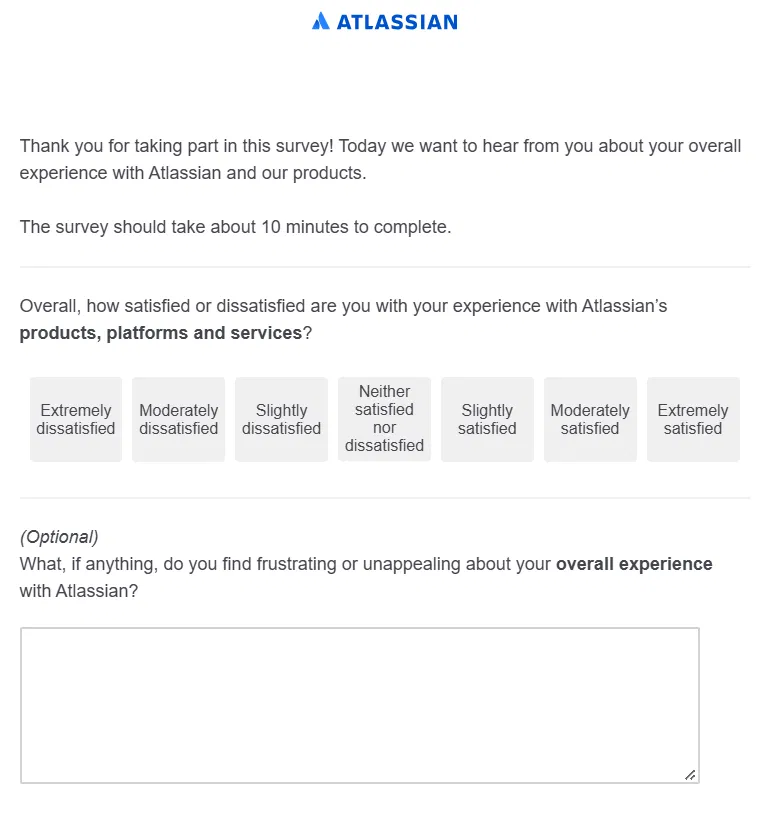
Atlassian survey with a 7-point satisfaction scale and an optional free text box

Now compare that to this: Airbnb changed its rules, and this is how customers reacted on X. The original post received over 200K views, with replies bringing up everything from cleaning fees to paying for a full day despite a 4 PM check-in.
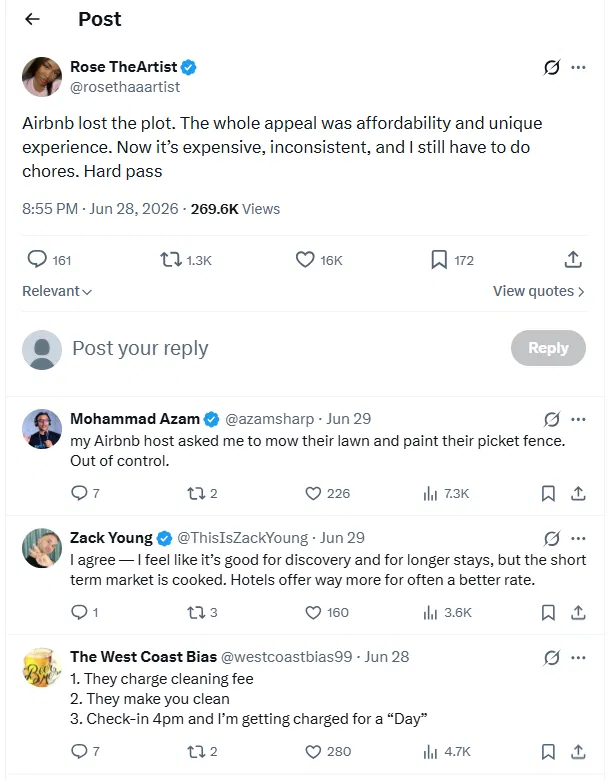
X post about Airbnb pricing with replies about cleaning fees and check-in charges
Via X

Here's another example. An unprompted Trustpilot review about Aveeno's new formula, where a regular customer who buys the product every week explains exactly what changed, why they're unhappy, and what it would take to win them back.
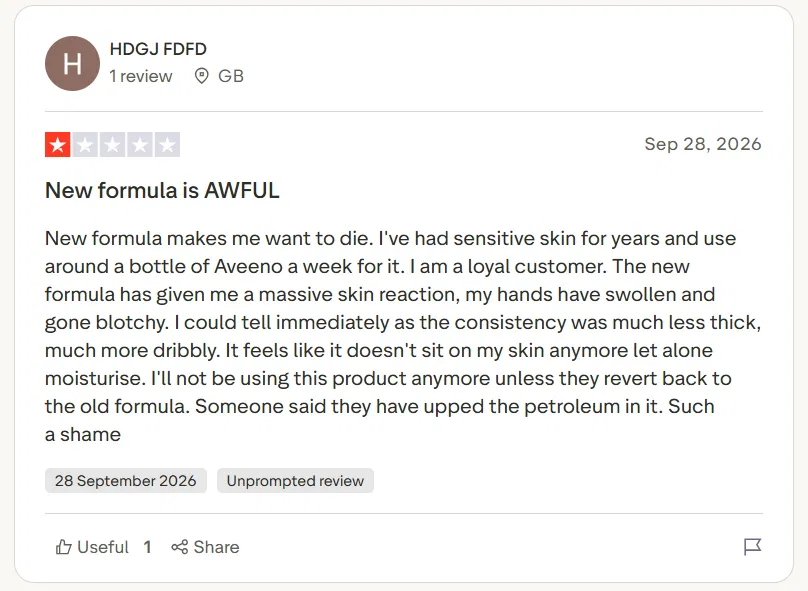
Trustpilot review of Aveeno marked unprompted, describing a formula change
Via Trustpilot

So, when you learn how to find customer pain points in unprompted conversations, what do you actually get?

  • Specific problems: Instead of simply saying they're dissatisfied, customers explain what's wrong. For example, "The consistency is thinner, and it doesn't sit on my skin the same way."
  • Context behind the complaint: Which model or batch they're using, where they bought it, how long they've been a customer, and what they've switched to.
  • Reactions from other customers: Replies can confirm similar experiences, challenge the original complaint, or reveal whether others are facing the same issue.
  • Clues about what could win customers back: People often explain exactly what they want brands to fix, restore, or improve.
  • Feedback as problems emerge: These conversations happen while customers are experiencing the issue, rather than waiting for the next survey cycle.

31.2% of brand-related X posts had no account handle at all

If you're only tracking tags, you're missing conversations. Clayface helps uncover untagged mentions across social media, reviews, and communities.

Start a 14-day parallel run

The 4 types of customer pain points, plus 4 that only surface unprompted
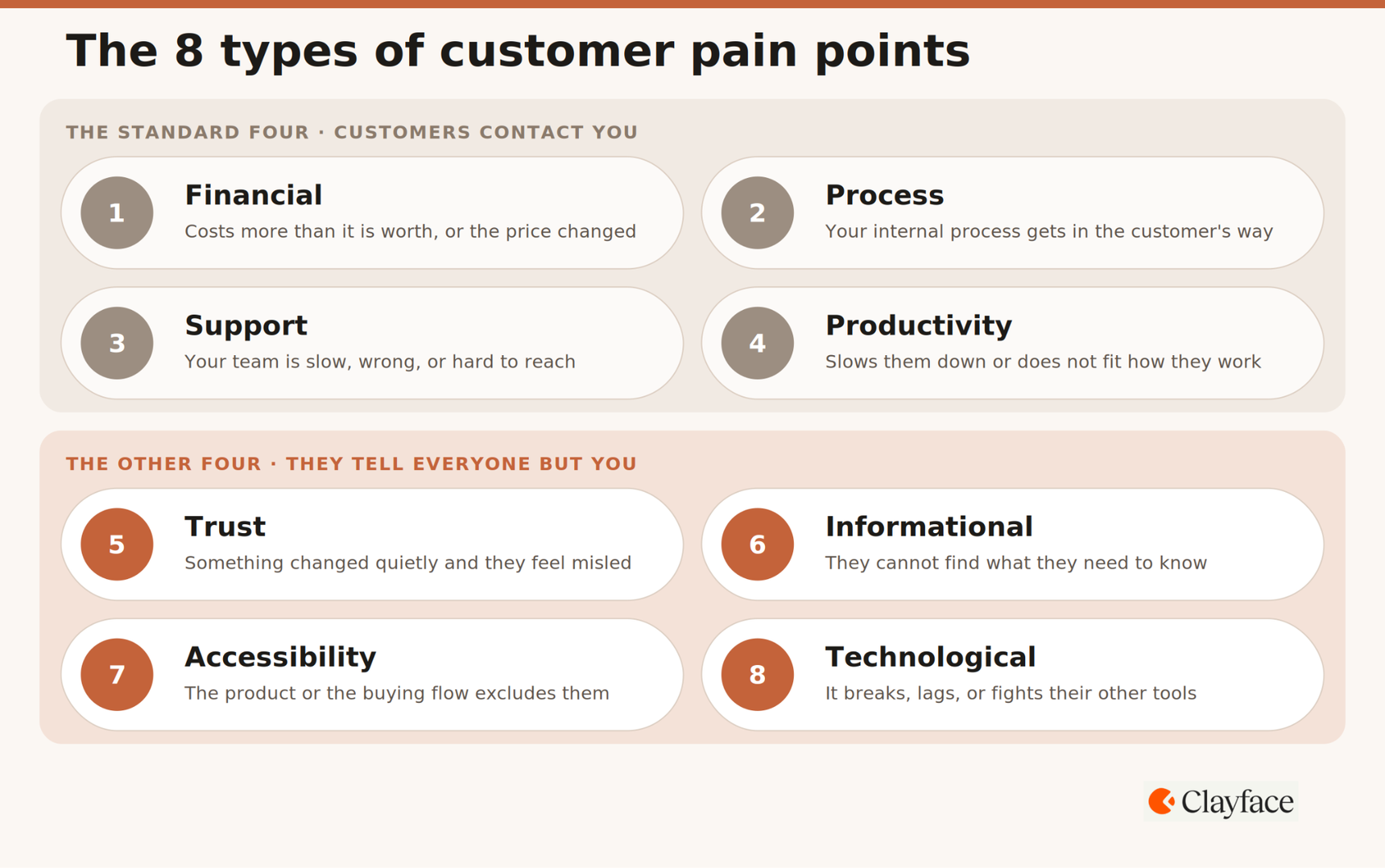
The 8 types of customer pain points, four reported to support and four found only in public conversation
8 types of customer pain points that you fully uncover via social listening

Most guides divide customer pain points into 4 categories because those are often the problems customers actively report to support teams. There are 4 more that rarely reach a support ticket, and we will get to those as well here.

1. Financial pain points

Customers feel they're paying more than the product or service is worth, or they're unhappy with unexpected charges and price increases.

Example: "The price went up 40%, and I still have to pay a cleaning fee on top."

2. Process pain points

A company's processes can make things unnecessarily difficult, whether that's placing an order, returning a product, or getting a refund.

In 2024, marketplace Mercari changed its return policy to allow buyers to return items for any reason. Sellers weren't happy and began sharing their experiences on Reddit. One seller reported four returns in a single week, compared with just three returns across their previous 700 orders.

The backlash was strong enough that Mercari reversed the policy less than two months later, saying it had listened to feedback from its seller community.

3. Support pain points

Customers struggle to get the help they need because support is slow, unhelpful, or difficult to reach.

Example: "This is the third time I've had to explain the same issue to a different agent."

4. Productivity pain points

The product makes customers work harder than they should or doesn't quite fit into their existing workflow.

Example: "It does 90% of what I need, but I still have to do the remaining 10% in a spreadsheet."

But when you track customer conversations online, you'll realize that people don't always contact a company when they lose trust in its products or find something difficult to use. A lot of the time, they simply stop buying and explain their reasons on Reddit, YouTube, or another public platform.

That's where the other 4 additional types of customer pain points become particularly useful.

5. Trust pain points

Customers can lose trust when brands quietly change a product or its pricing. For example, in late 2024, Chick-fil-A added pea starch to its waffle fries to keep them crispier. Customers noticed the change in taste and texture and began complaining online, with many asking for the original recipe back. By early 2026, Chick-fil-A had removed pea starch, and customers were once again discussing the change online.
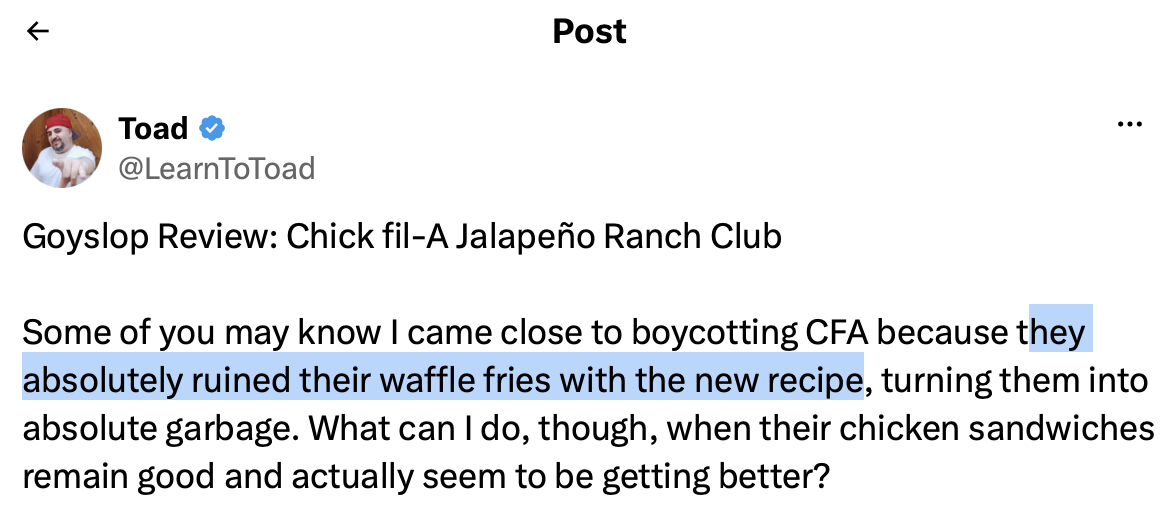
An X user criticizes Chick-fil-A's changed waffle fries recipe, saying the new version ruined the taste and quality of the fries
Via X

6. Informational pain points

Customers can't always find the information they need, and sometimes even what's written on the packaging leaves them confused.

Hershey faced criticism over its use of substitute ingredients in some Reese's products and other candies. Customers questioned labels using terms like "made with chocolate" and "chocolatey," which didn't make the ingredient changes obvious to everyone. The backlash grew to the point that Hershey announced plans to return affected products to their original recipes in 2027.

Excerpt from Hershey's announcement that it will return to its original recipes for Hershey's and Reese's products after label fiasco and customer backlash
Via Philly Voice

7. Accessibility pain points

A product or buying experience is difficult or impossible to use for customers with particular physical, sensory, or cognitive needs.

Example: "The lid is almost impossible to open when you have arthritis in your hands."

8. Technological pain points

Software updates, bugs, and compatibility issues can quickly become customer pain points, especially when they affect features people use every day.

Here's a lesson from Sonos' book. The company designed its app in May 2024, essentially removing familiar features, including playlist editing. Naturally, customers began complaining across Reddit and Sonos forums. The backlash continued for weeks until CEO Patrick Spence publicly apologized in July and outlined a schedule of updates to restore missing functionality.

These last four pain points are especially important to understand why customers are considering alternatives or choosing not to buy again.

Where to find customer pain points online

Here’s how to identify customer pain points online.

WhereBest forWhat it misses
Social posts and commentsSpotting that something changed, fastThe reason behind the reaction
Review sites and digital shelfDetail from people who actually boughtAnyone who did not bother to write
Forums and communitiesThe most honest version of the problemVolume, and threads are scattered
Video and audioComplaints shown and spoken out loudMost tools stop at captions. Clayface reads the video, the audio, and the product on screen
Your own search and support dataWhat people wanted and could not findAnyone not already on your site

The table covers pretty much everything we've discussed so far. But to understand how to find customer pain points online, let's look at how they show up across different platforms and content formats, so it's easier to recognize the patterns when we come across them.

Social posts and comment sections

Social media is pretty much where the bulk of the feedback comes from. However, context can sometimes get lost along the way. For instance, if you're seeing a spike in mentions after a packaging update, it tells you that people have noticed the change, but you'll have to do some digging to find out whether the reactions are positive or negative.

Comment sections are the other underused half. Sure, the original post might attract most of the attention, but the replies are usually where the gold is.

Here’s a classic packaging complaint and how Dunkin’ handled the situation:
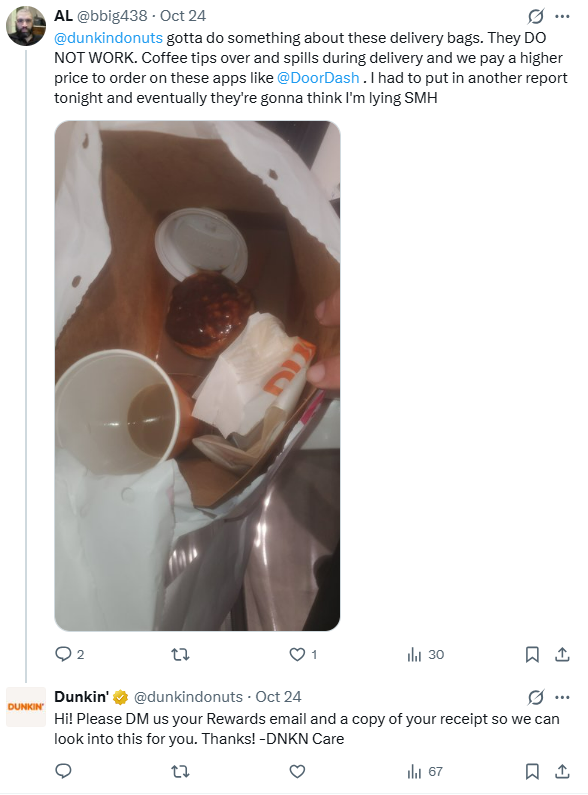
Customer complaint about Dunkin packaging on X with the brand replying
Via X

Review sites and marketplace listings

The useful reviews are the 2 and 3 star ones. A 1 star review is often about shipping. A 5 star review says “love it.” The middle is where someone liked the product enough to explain exactly what let them down.

Reviews also carry more weight than brands expect. A survey asked US TikTok Shop users what convinced them to buy, and Star ratings and written reviews came first at 74%. Influencer endorsement came last at 31%. On a platform built entirely on creators, shoppers still trusted other buyers more than the person selling to them.

Here are a few Amazon reviews of a puppy puzzle toy, and all 3-star reviews point to the same problem: the toy isn't engaging enough for puppies older than 3 months. Some customers have even included videos to show what they mean. This recurring pattern gives the brand something specific to potentially improve.

Three-star Amazon reviews of a puppy puzzle toy saying it is too easy and slides on the floor
Via Amazon

An average of 3.4 stars tells a brand the product is fine. Clayface reads the text of every review and groups it by subject, so “too easy” and “slides around” come back as 2 named issues with a count against each. Look how easy it becomes for you to track these issues:
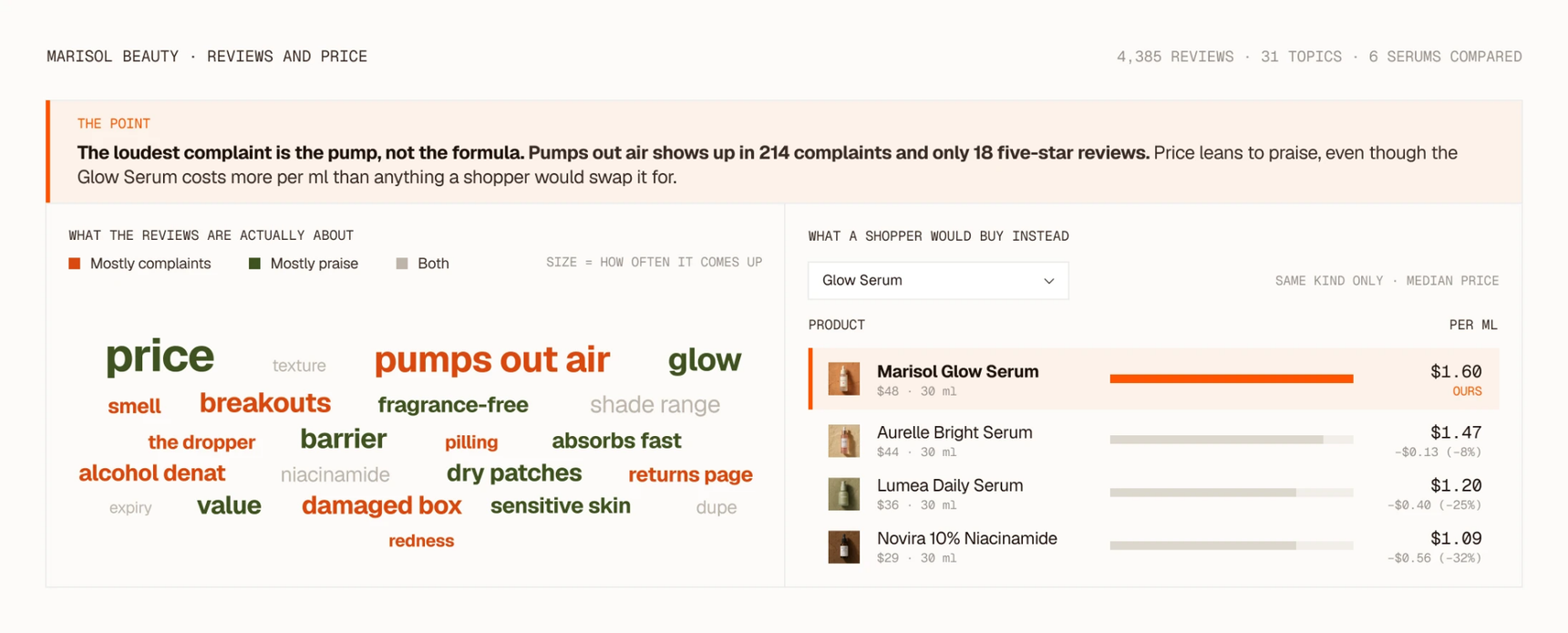
Clayface grouping product reviews by subject with a count against each issue
Clayface reads every customer review and sorts them by subject and theme

Forums and communities

Forums are usually where these conversations happen in lower volumes, but the feedback can be brutally honest. People are often reaching out to others for opinions, advice, or help making a decision. So the language tends to be blunt, but you can very easily tell what customers deem as pros and cons about your product.

You can also get a better sense of whether a complaint is an isolated experience or something multiple customers are dealing with. You can even see if the issue is recurring in specific regions or reported by customers globally. Like this Dyson review on Reddit:
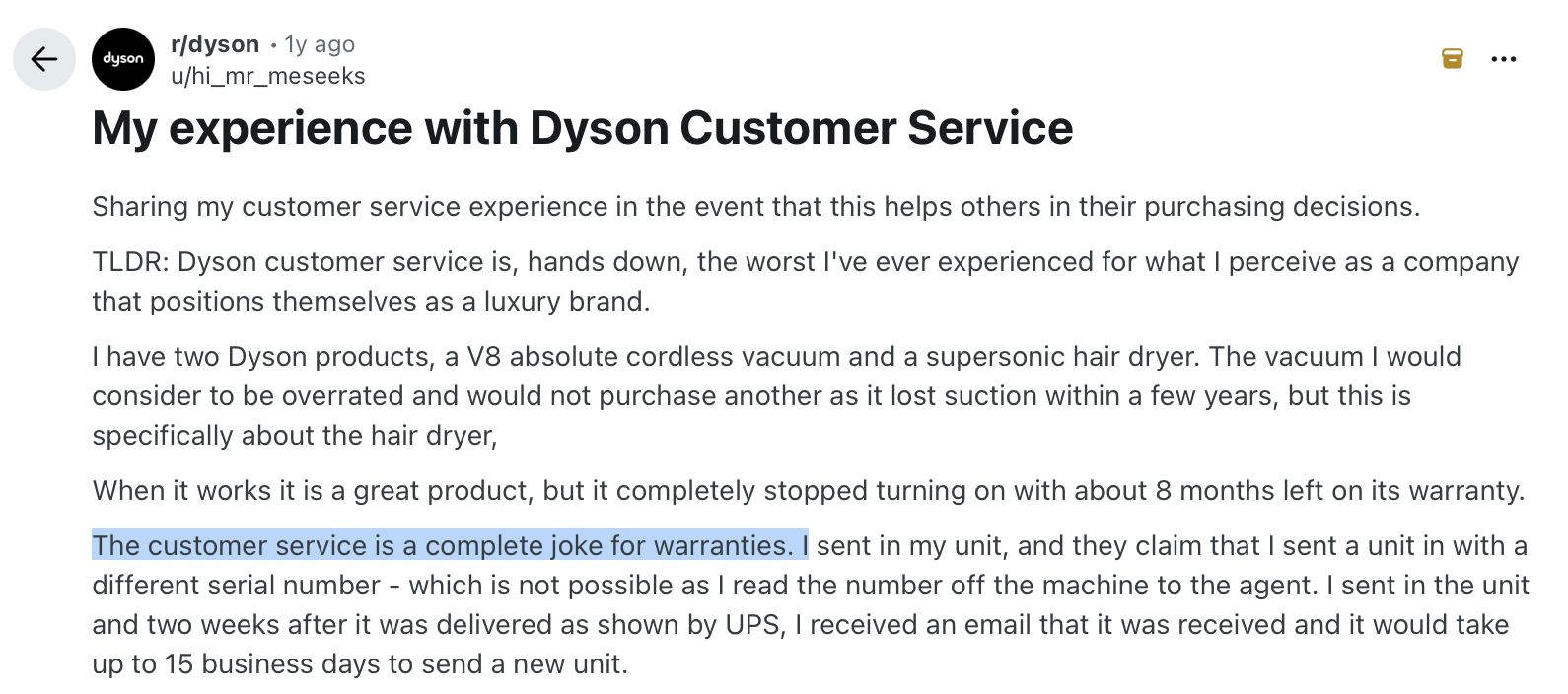
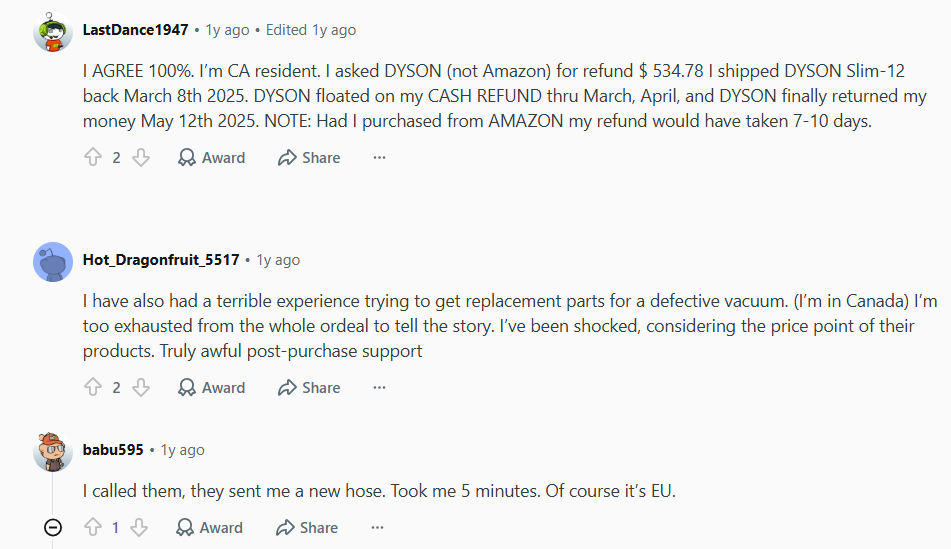
Reddit thread where Dyson owners compare the same fault across different units
Via Reddit
Reddit thread where Dyson owners compare the same fault across different units

Video and audio

Short-form videos and visual content

Reels, TikToks, and YouTube Shorts are the largest body of unprompted customer opinion online.

Most brands already use tools to track videos uploaded across social platforms and understand customer sentiment. But the problem with many of these tools is that they rely heavily on captions, descriptions, and other text they can read.

For example, take this video of a dermatologist recommending skincare products for different skin conditions. She shows which products people should use and which ones they should avoid, holding up the actual packaging so viewers can recognize them. But she doesn't explicitly name the brands, and the video description contains very little information.
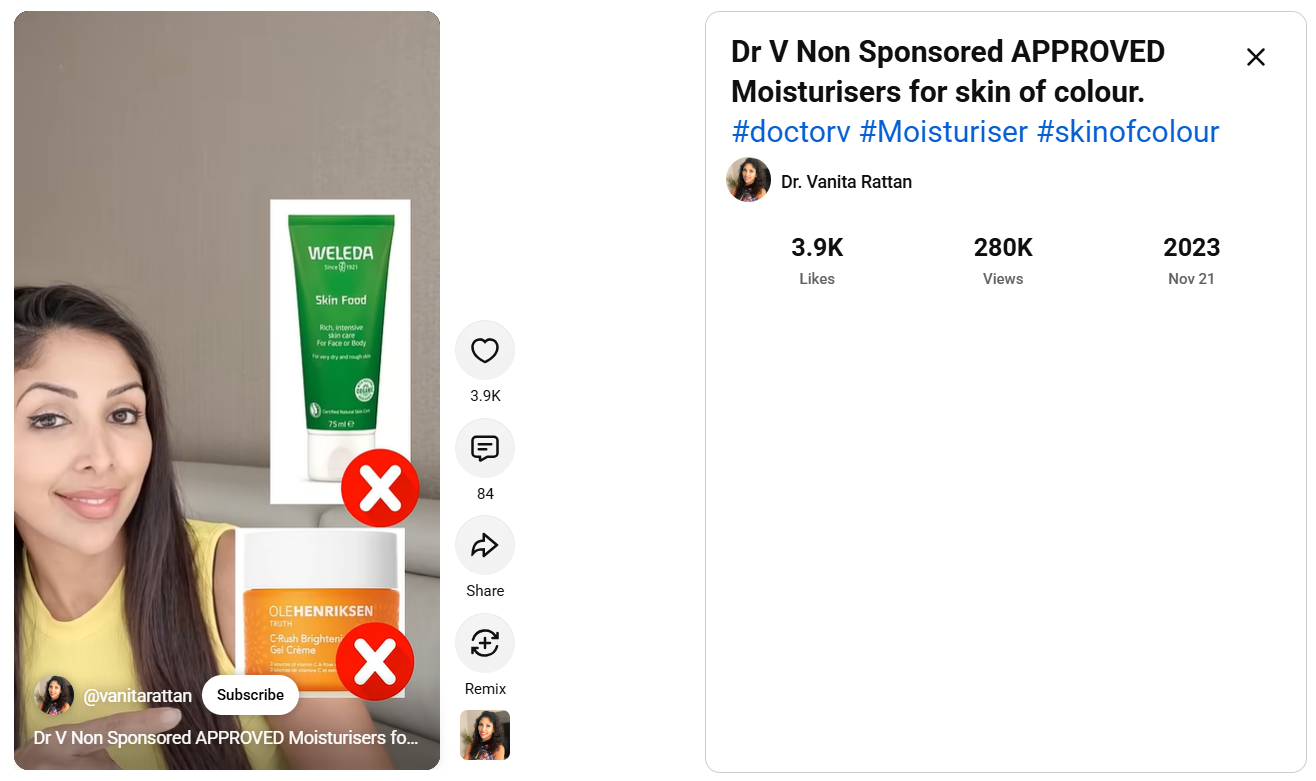
Dermatologist holding up skincare packaging on camera without naming the brand in the caption
Via YouTube

A tool that only analyzes captions and descriptions could miss these brand mentions entirely, along with the recommendations and warnings associated with each product.

But not all tools have this limitation. Clayface offers a multi-dimensional social listening and intelligence tool that can analyze what's happening within a video, including spoken audio, on-screen text, and products or logos appearing in the frame.

It then brings these findings together in a detailed report, as shown below, with timestamps, sentiment analysis, creator information, and other relevant details.
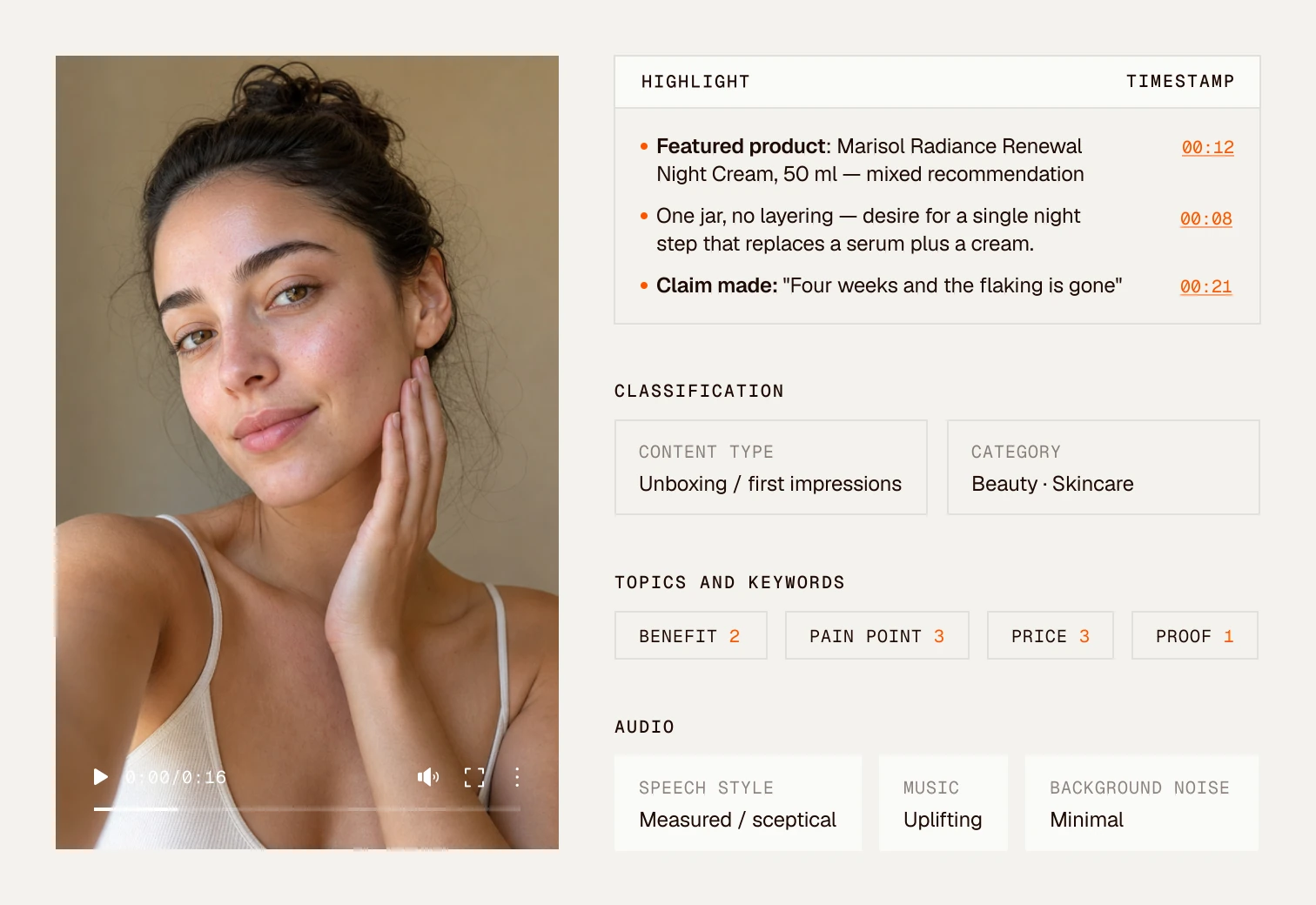
Clayface video analysis showing timestamps, sentiment, creator details, and products found in the frame

68% of consumers have changed their opinion of a brand after social conversations

Most of the time, without tagging brands. Clayface finds these conversations and helps you understand which complaints are shaping customer opinions.

Start a 14-day parallel run

Your own search and support data

Imagine you run an online skincare brand.

A customer visits your website and searches for "moisturizer for sensitive skin." They get no results, even though you sell moisturizers. 200 other customers also search for similar terms.

This tells you two things:

  1. Customers are actively looking for products suitable for sensitive skin.
  2. Your website isn't helping them find those products, either because they're missing or because they're not labelled properly.

These searches are called zero-result queries, meaning customers searched for something, but your website returned no matching results.

If you're wondering how to identify customer pain points on your own website, start with these searches. You already have access to this data through your website's search analytics. You don't need to wait for customers to complain or fill out a survey to identify these gaps.

How to pull customer pain points out of raw conversations

Now that you know how to find customer pain points, turning a pile of threads, comments, and reviews into something substantial is the tricky bit. Here are three useful habits to build.

1. Search for problems without your brand name

When someone complains that a moisturizer feels sticky or an electric toothbrush stops after a few months, they might not mention the brand at all.

So, if you're figuring out how to identify customer pain points without relying on brand mentions, look for phrases people naturally use when something isn't working for them. Here are a few examples:

  • "Why did they change..."
  • "Used to be better"
  • "Anyone else having this problem?"
  • "I switched to..."
  • "Stopped working after..."
  • "Wish it had..."
  • "Not worth the money"
  • "Looking for an alternative"

For example, searching site:reddit.com "stopped working after" electric toothbrush could surface durability complaints across brands, including competitors. This way, you're also learning what frustrates customers across the category.
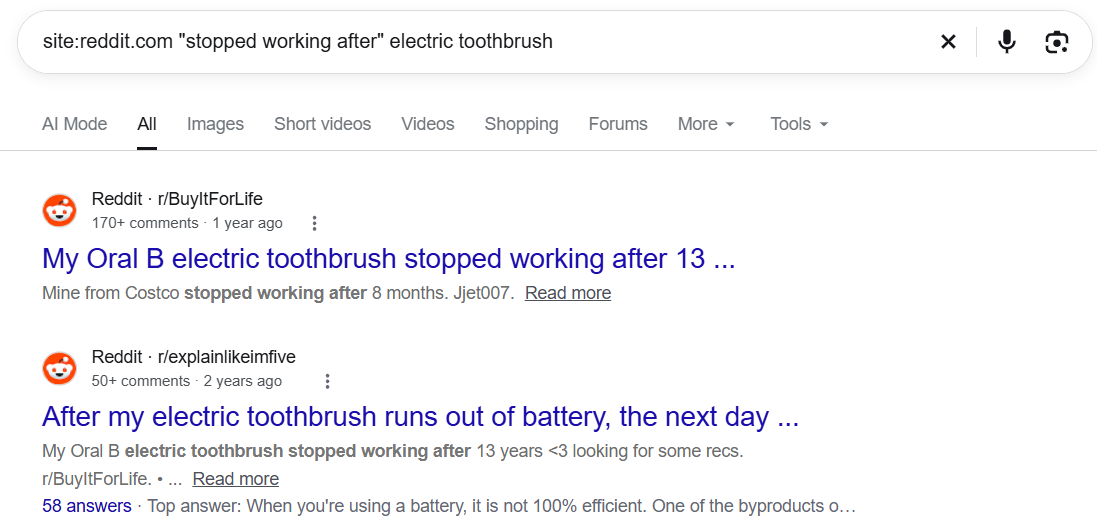
Google results for a site:reddit.com search showing customer pain points across a product category
One phrase search surfaces complaints across every brand in the category

2. Use technology to find patterns at scale

When you're manually researching customer pain points, you would typically start with a sample of 40 to 60 reviews. Once you start seeing the same problems come up, you have a reasonable idea of what customers are struggling with.

But sampling comes at a cost. You're only analyzing a small portion of the conversation, which means you could miss an important complaint buried in the 300th Reddit thread.

Instead of spending hours on this, Clayface tracks conversations across social media, videos, reviews, retailer listings, forums, and communities. It brings these conversations together and groups them by themes, helping you identify recurring pain points.
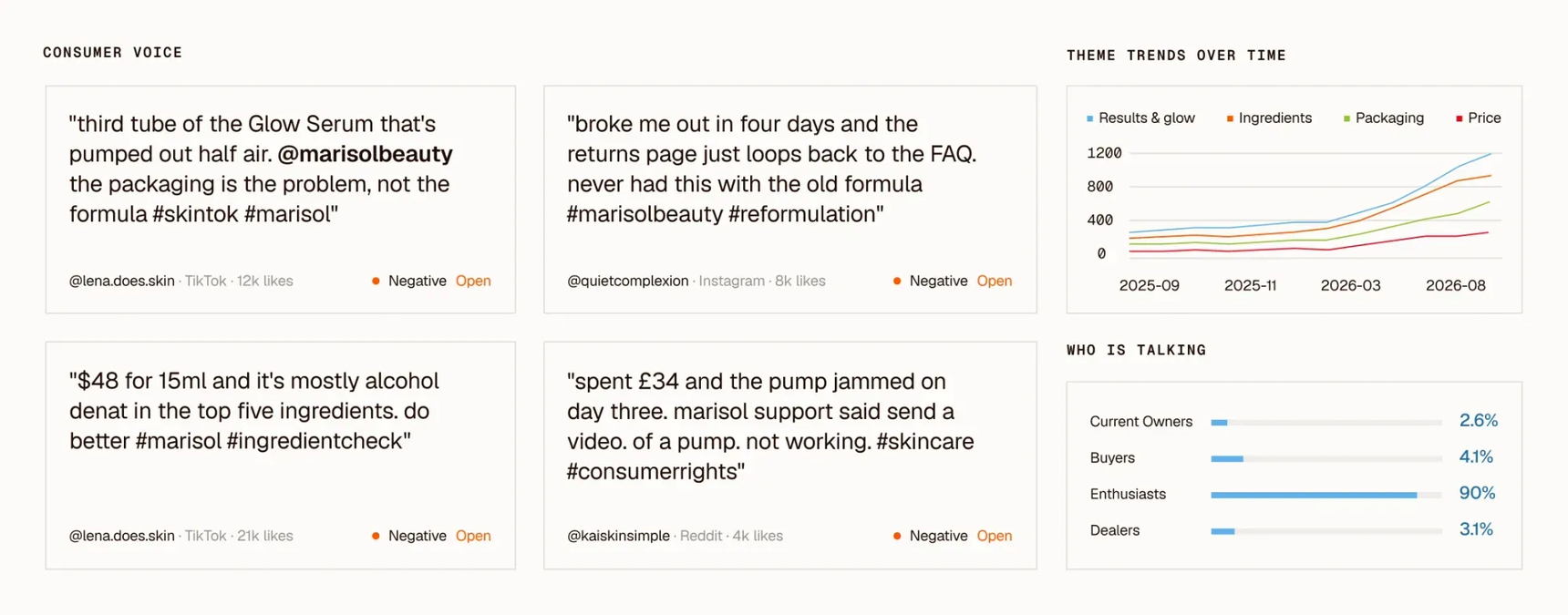
Clayface grouping conversations from social, reviews, forums, and video into recurring themes
Clayface groups customer conversations from social, reviews, forums, and video into recurring themes

3. Keep the customer's original words

A customer might describe a moisturizer as "sticky and gloopy," but by the time that feedback reaches the product team, it becomes something like "customers are dissatisfied with the product texture."

In the second version, the product team no longer knows exactly what the customer experienced, and the marketing team loses the language customers naturally use to describe the product.

Instead, you can create your own themes and filter conversations by product line, SKU, market, audience, or platform using Clayface's Voice of the Customer.
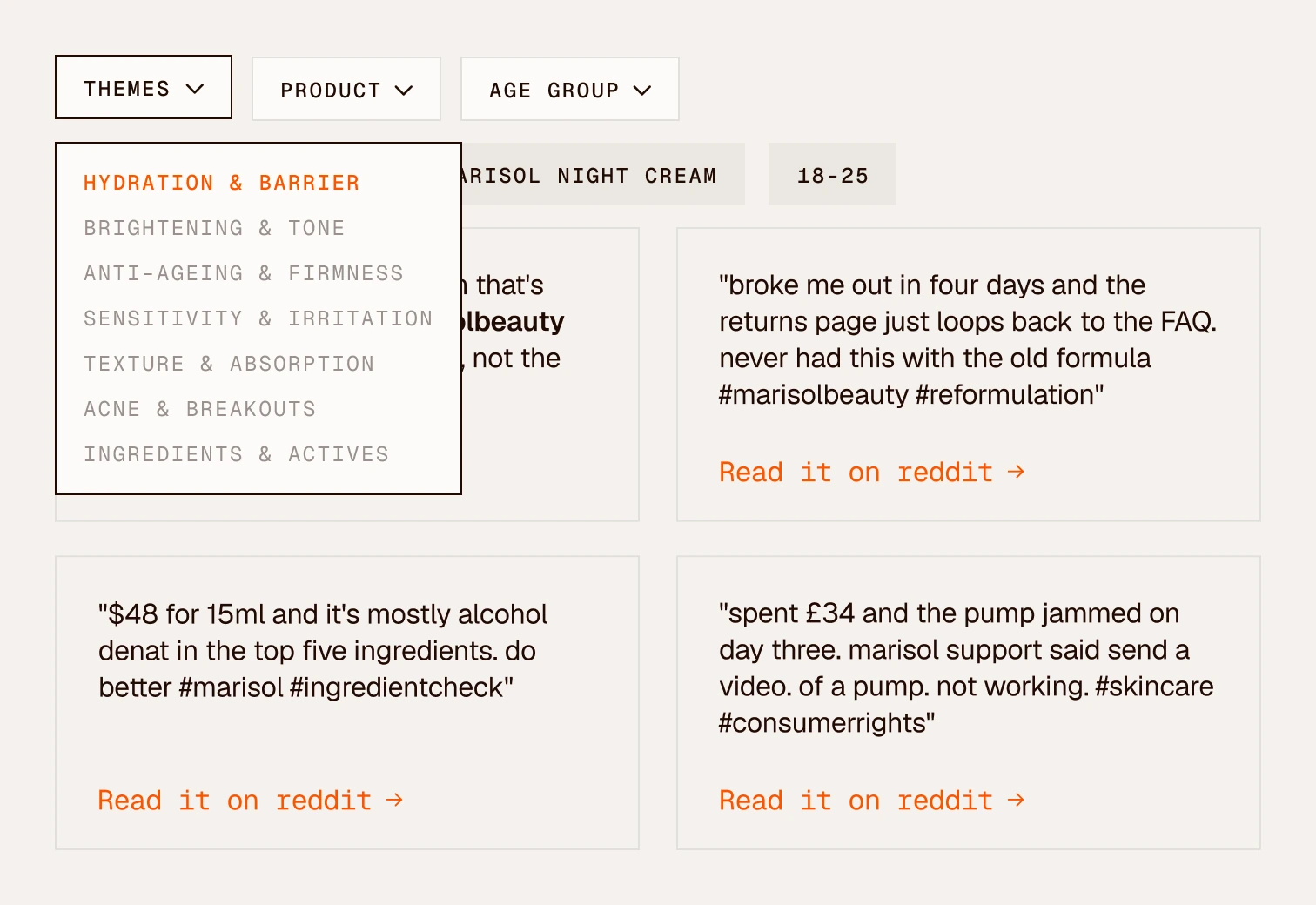
Clayface Voice of the Customer themes filtered by product and audience with the customer quotes underneath

So, if your dashboard shows that customers frequently complain about a product's texture, you can open that theme and read exactly what they're saying instead of relying on a broad label like "negative product sentiment."

Here's how these insights helped the head of ecommerce at a global beauty retailer we were working with:

"One product lost half a star across three retailers in a month. It turned out to be the packaging, not the product, and we would never have found that in a rating."

What to do once you find customer pain points

Once you have that list of pain points, assign each one an owner and a stage in the customer journey. Like this:
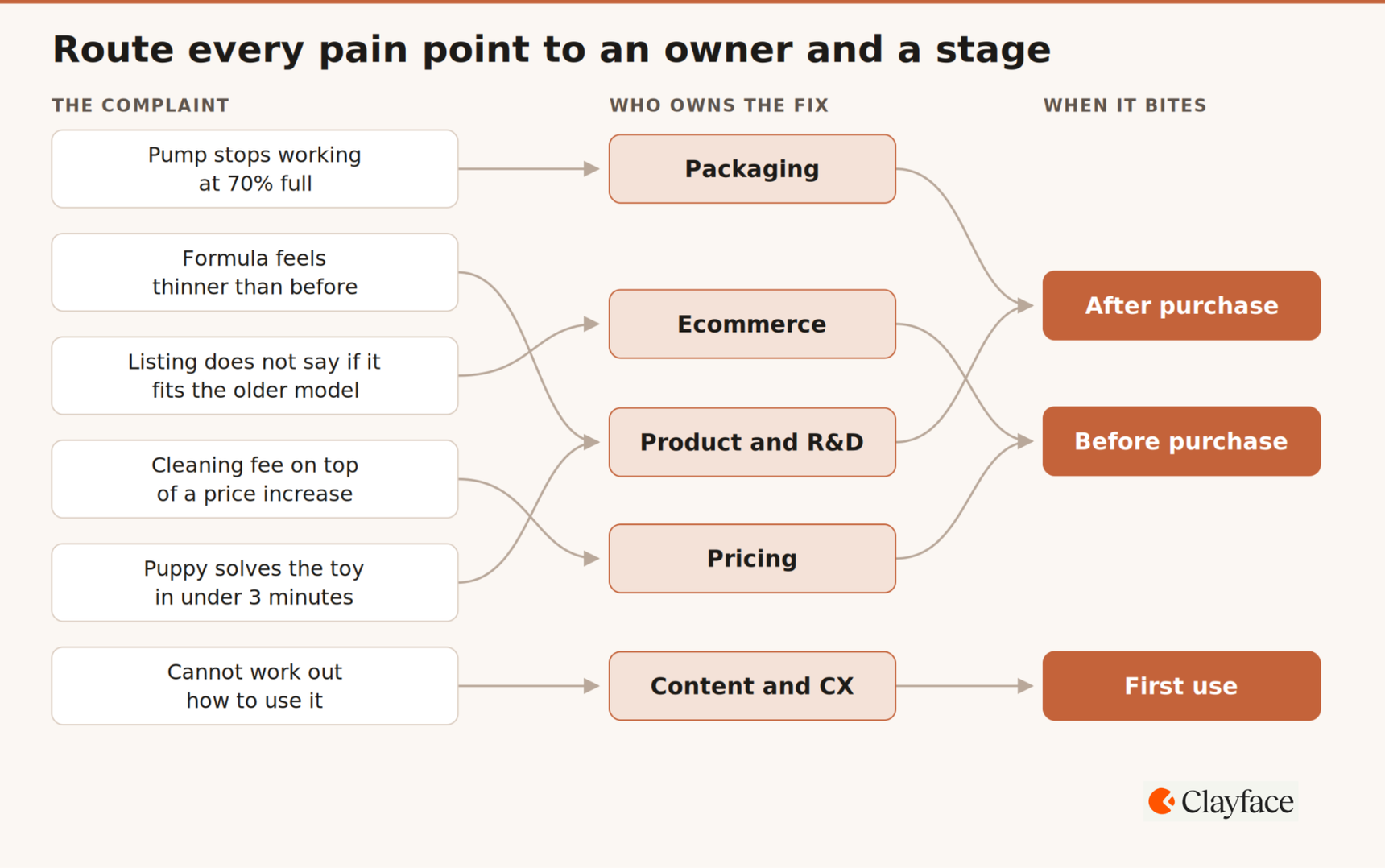
Flowchart routing customer pain points to an owner and a customer journey stage
Every customer pain point needs an owner and a stage to keep things moving

Also, remember that customer feedback isn't a one-time research project. Customers will continue sharing their experiences, and new problems can appear even after updates. That's why having a continuous view of what customers are saying is sustainable long-term.

As discussed, Clayface brings conversations from social media, Reddit, forums, reviews, and videos into one place. If you're already using a social listening tool? You can also compare its coverage with Clayface to see which customer conversations and pain points your current setup might be missing.

Book a demo!

How to Find Customer Pain Points in Unprompted Online Conversations

Learn how to find customer pain points through unprompted feedback, social listening, reviews, and Reddit conversations, with real examples and actionable tips.

Ross Bose
Ross Bose
October 30, 2026
Published:
October 30, 2026
Updated:
How to Find Customer Pain Points in Unprompted Online Conversations

Summarize this article with AI

Table of Contents

TL;DR

  • Unprompted customer pain points are problems people share without being asked, across Reddit, Amazon reviews, YouTube, TikTok, X, and niche forums.
  • Surveys can miss these conversations. Ecommerce email surveys average a 3.24% response rate, and the questions limit what customers get to discuss.
  • There are 8 types of customer pain points. Financial, process, support, and productivity issues often reach support teams. Trust, informational, accessibility, and technological issues may go unreported.
  • To find customer pain points online, search phrases like "used to be better" or "stopped working after" + the category, rather than just brand names. You'll also uncover complaints about competitors.
  • Caption-based tools can miss complaints spoken or shown in videos. Clayface analyzes audio, on-screen text, and visible products, grouping findings by theme while keeping customers' original words.

By the late 1990s, the internet had become a major platform for customer feedback, with conversations shifting to review sites and marketplace star ratings.

But it would be foolish to assume that honest customer insights are only collected through surveys or feedback forms. They're also found in unprompted conversations happening across social media, forums, and comment sections.

And brands that pay attention are already acting on them. In 2022, two TikTok creators popularized a menu hack involving a steak quesadilla with fajita vegetables and a custom sauce made from Chipotle's vinaigrette and sour cream. After the trend generated over 30 million views, Chipotle officially introduced the Fajita Quesadilla in March 2023, turning a customer-created combination into a menu item.

But what do these unprompted conversations actually look like? Here's a great example from Reddit.

Reddit comment on an iPhone 17 thread saying iOS used to feel snappier than it does now, unprompted customer pain point via social listening
Via Reddit

This is from a longtime Android user sharing their experience after using the iPhone 17 for a month.

While the post itself contains plenty of useful information, the comments get specific very quickly. One user points out that iOS used to feel much snappier and that every new update brings it a little closer to how it was, but it's still not quite there.

Here's another example from a YouTube review of the same phone, with over 300 comments underneath.

YouTube comment under an iPhone 17 review recommending the older model over the new one, unprompted customer pain point via social listening
Via YouTube

One of the top comments breaks down the phone's shortcomings and recommends buying the older model instead. The conversation continues - other users jump in, share their perspectives, and continue discussing the trade-offs.

My point is that these are the places where people talk about products after actually living with them for weeks or even months. Their feedback is often incredibly specific, and it's not just complaints. Sometimes, people talk about features they miss from older models and wish the company would bring back, or new improvements they'd like to see in the next release.

Many brands don't systematically monitor these interactions, but learning how to find customer pain points in them opens up product research, pricing research, and even messaging research, all served up on a silver platter.

What an unprompted customer pain point is and why brands should care

Prompted feedback is usually designed by the brand. Customers answer questions or choose from options that are already framed in the brand's own words.

But what exactly qualifies as an unprompted customer pain point? It's a problem that a customer describes publicly without anyone asking them to. The easiest way to remember the difference is that unprompted feedback is always volunteered.

And the biggest reason brands should care about this kind of feedback is that 97% of shoppers consult multiple sources before making a purchase.

Before buying a new gadget, most of us probably watch a bunch of YouTube reviews, browse Reddit threads, and ask friends or family for their opinions. I have friends who go down this research rabbit hole simply before trying a new gluten-free bread.

At Clayface, we're seeing a direct correlation between negative comments, posts, and videos and a decline in products sold through digital shelves. And I can relate to that as a consumer. I even find myself second-guessing a purchase when I come across a convincing negative review from another customer.

Here's an easy table comparing prompted and unprompted feedback.

PromptedUnprompted
Who you hear fromA small, self-selected slice. Ecommerce email surveys average a 3.24% response rate across more than 25 million invitationsAnyone who felt strongly enough to post. 1 in 3 use Reddit specifically for pre-purchase research
BiasThe question sets the frame and people soften the answer. Short surveys of 2 to 3 questions get a 15.97% median responseNobody is watching, so the wording is honest and often unflattering
RecencyTied to your survey calendar, usually monthly or quarterlyContinuous, complaints appear within days of the problem
Level of feedback detailYou only learn what you think to ask. Most answers are a score plus one line of free textSpecific. Model, batch, retailer, what they switched to, what they want next
CostPanel fees, incentives, and research timeFree to read, expensive to find at scale

What unprompted conversation gives you that surveys cannot

Here's an email I received from Atlassian asking for feedback.

Atlassian email asking users to take a feedback survey

And here's what opens when you click through. A 10-minute survey that starts with a 7-point satisfaction scale. The only field where you can actually describe a problem in your own words is optional.

Atlassian survey with a 7-point satisfaction scale and an optional free text box

Now compare that to this: Airbnb changed its rules, and this is how customers reacted on X. The original post received over 200K views, with replies bringing up everything from cleaning fees to paying for a full day despite a 4 PM check-in.

X post about Airbnb pricing with replies about cleaning fees and check-in charges
Via X

Here's another example. An unprompted Trustpilot review about Aveeno's new formula, where a regular customer who buys the product every week explains exactly what changed, why they're unhappy, and what it would take to win them back.

Trustpilot review of Aveeno marked unprompted, describing a formula change
Via Trustpilot

So, when you learn how to find customer pain points in unprompted conversations, what do you actually get?

  • Specific problems: Instead of simply saying they're dissatisfied, customers explain what's wrong. For example, "The consistency is thinner, and it doesn't sit on my skin the same way."
  • Context behind the complaint: Which model or batch they're using, where they bought it, how long they've been a customer, and what they've switched to.
  • Reactions from other customers: Replies can confirm similar experiences, challenge the original complaint, or reveal whether others are facing the same issue.
  • Clues about what could win customers back: People often explain exactly what they want brands to fix, restore, or improve.
  • Feedback as problems emerge: These conversations happen while customers are experiencing the issue, rather than waiting for the next survey cycle.

31.2% of brand-related X posts had no account handle at all

If you're only tracking tags, you're missing conversations. Clayface helps uncover untagged mentions across social media, reviews, and communities.

Start a 14-day parallel run

The 4 types of customer pain points, plus 4 that only surface unprompted

The 8 types of customer pain points, four reported to support and four found only in public conversation
8 types of customer pain points that you fully uncover via social listening

Most guides divide customer pain points into 4 categories because those are often the problems customers actively report to support teams. There are 4 more that rarely reach a support ticket, and we will get to those as well here.

1. Financial pain points

Customers feel they're paying more than the product or service is worth, or they're unhappy with unexpected charges and price increases.

Example: "The price went up 40%, and I still have to pay a cleaning fee on top."

2. Process pain points

A company's processes can make things unnecessarily difficult, whether that's placing an order, returning a product, or getting a refund.

In 2024, marketplace Mercari changed its return policy to allow buyers to return items for any reason. Sellers weren't happy and began sharing their experiences on Reddit. One seller reported four returns in a single week, compared with just three returns across their previous 700 orders.

The backlash was strong enough that Mercari reversed the policy less than two months later, saying it had listened to feedback from its seller community.

3. Support pain points

Customers struggle to get the help they need because support is slow, unhelpful, or difficult to reach.

Example: "This is the third time I've had to explain the same issue to a different agent."

4. Productivity pain points

The product makes customers work harder than they should or doesn't quite fit into their existing workflow.

Example: "It does 90% of what I need, but I still have to do the remaining 10% in a spreadsheet."

But when you track customer conversations online, you'll realize that people don't always contact a company when they lose trust in its products or find something difficult to use. A lot of the time, they simply stop buying and explain their reasons on Reddit, YouTube, or another public platform.

That's where the other 4 additional types of customer pain points become particularly useful.

5. Trust pain points

Customers can lose trust when brands quietly change a product or its pricing. For example, in late 2024, Chick-fil-A added pea starch to its waffle fries to keep them crispier. Customers noticed the change in taste and texture and began complaining online, with many asking for the original recipe back. By early 2026, Chick-fil-A had removed pea starch, and customers were once again discussing the change online.

An X user criticizes Chick-fil-A's changed waffle fries recipe, saying the new version ruined the taste and quality of the fries
Via X

6. Informational pain points

Customers can't always find the information they need, and sometimes even what's written on the packaging leaves them confused.

Hershey faced criticism over its use of substitute ingredients in some Reese's products and other candies. Customers questioned labels using terms like "made with chocolate" and "chocolatey," which didn't make the ingredient changes obvious to everyone. The backlash grew to the point that Hershey announced plans to return affected products to their original recipes in 2027.

Excerpt from Hershey's announcement that it will return to its original recipes for Hershey's and Reese's products after label fiasco and customer backlash
Via Philly Voice

7. Accessibility pain points

A product or buying experience is difficult or impossible to use for customers with particular physical, sensory, or cognitive needs.

Example: "The lid is almost impossible to open when you have arthritis in your hands."

8. Technological pain points

Software updates, bugs, and compatibility issues can quickly become customer pain points, especially when they affect features people use every day.

Here's a lesson from Sonos' book. The company designed its app in May 2024, essentially removing familiar features, including playlist editing. Naturally, customers began complaining across Reddit and Sonos forums. The backlash continued for weeks until CEO Patrick Spence publicly apologized in July and outlined a schedule of updates to restore missing functionality.

These last four pain points are especially important to understand why customers are considering alternatives or choosing not to buy again.

Where to find customer pain points online

Here’s how to identify customer pain points online.

WhereBest forWhat it misses
Social posts and commentsSpotting that something changed, fastThe reason behind the reaction
Review sites and digital shelfDetail from people who actually boughtAnyone who did not bother to write
Forums and communitiesThe most honest version of the problemVolume, and threads are scattered
Video and audioComplaints shown and spoken out loudMost tools stop at captions. Clayface reads the video, the audio, and the product on screen
Your own search and support dataWhat people wanted and could not findAnyone not already on your site

The table covers pretty much everything we've discussed so far. But to understand how to find customer pain points online, let's look at how they show up across different platforms and content formats, so it's easier to recognize the patterns when we come across them.

Social posts and comment sections

Social media is pretty much where the bulk of the feedback comes from. However, context can sometimes get lost along the way. For instance, if you're seeing a spike in mentions after a packaging update, it tells you that people have noticed the change, but you'll have to do some digging to find out whether the reactions are positive or negative.

Comment sections are the other underused half. Sure, the original post might attract most of the attention, but the replies are usually where the gold is.

Here’s a classic packaging complaint and how Dunkin’ handled the situation:

Customer complaint about Dunkin packaging on X with the brand replying
Via X

Review sites and marketplace listings

The useful reviews are the 2 and 3 star ones. A 1 star review is often about shipping. A 5 star review says “love it.” The middle is where someone liked the product enough to explain exactly what let them down.

Reviews also carry more weight than brands expect. A survey asked US TikTok Shop users what convinced them to buy, and Star ratings and written reviews came first at 74%. Influencer endorsement came last at 31%. On a platform built entirely on creators, shoppers still trusted other buyers more than the person selling to them.

Here are a few Amazon reviews of a puppy puzzle toy, and all 3-star reviews point to the same problem: the toy isn't engaging enough for puppies older than 3 months. Some customers have even included videos to show what they mean. This recurring pattern gives the brand something specific to potentially improve.

Three-star Amazon reviews of a puppy puzzle toy saying it is too easy and slides on the floor
Via Amazon

An average of 3.4 stars tells a brand the product is fine. Clayface reads the text of every review and groups it by subject, so “too easy” and “slides around” come back as 2 named issues with a count against each. Look how easy it becomes for you to track these issues:

Clayface grouping product reviews by subject with a count against each issue
Clayface reads every customer review and sorts them by subject and theme

Forums and communities

Forums are usually where these conversations happen in lower volumes, but the feedback can be brutally honest. People are often reaching out to others for opinions, advice, or help making a decision. So the language tends to be blunt, but you can very easily tell what customers deem as pros and cons about your product.

You can also get a better sense of whether a complaint is an isolated experience or something multiple customers are dealing with. You can even see if the issue is recurring in specific regions or reported by customers globally. Like this Dyson review on Reddit:

Reddit thread where Dyson owners compare the same fault across different units
Via Reddit
Reddit thread where Dyson owners compare the same fault across different units

Video and audio

Short-form videos and visual content

Reels, TikToks, and YouTube Shorts are the largest body of unprompted customer opinion online.

Most brands already use tools to track videos uploaded across social platforms and understand customer sentiment. But the problem with many of these tools is that they rely heavily on captions, descriptions, and other text they can read.

For example, take this video of a dermatologist recommending skincare products for different skin conditions. She shows which products people should use and which ones they should avoid, holding up the actual packaging so viewers can recognize them. But she doesn't explicitly name the brands, and the video description contains very little information.

Dermatologist holding up skincare packaging on camera without naming the brand in the caption
Via YouTube

A tool that only analyzes captions and descriptions could miss these brand mentions entirely, along with the recommendations and warnings associated with each product.

But not all tools have this limitation. Clayface offers a multi-dimensional social listening and intelligence tool that can analyze what's happening within a video, including spoken audio, on-screen text, and products or logos appearing in the frame.

It then brings these findings together in a detailed report, as shown below, with timestamps, sentiment analysis, creator information, and other relevant details.

Clayface video analysis showing timestamps, sentiment, creator details, and products found in the frame

68% of consumers have changed their opinion of a brand after social conversations

Most of the time, without tagging brands. Clayface finds these conversations and helps you understand which complaints are shaping customer opinions.

Start a 14-day parallel run

Your own search and support data

Imagine you run an online skincare brand.

A customer visits your website and searches for "moisturizer for sensitive skin." They get no results, even though you sell moisturizers. 200 other customers also search for similar terms.

This tells you two things:

  1. Customers are actively looking for products suitable for sensitive skin.
  2. Your website isn't helping them find those products, either because they're missing or because they're not labelled properly.

These searches are called zero-result queries, meaning customers searched for something, but your website returned no matching results.

If you're wondering how to identify customer pain points on your own website, start with these searches. You already have access to this data through your website's search analytics. You don't need to wait for customers to complain or fill out a survey to identify these gaps.

How to pull customer pain points out of raw conversations

Now that you know how to find customer pain points, turning a pile of threads, comments, and reviews into something substantial is the tricky bit. Here are three useful habits to build.

1. Search for problems without your brand name

When someone complains that a moisturizer feels sticky or an electric toothbrush stops after a few months, they might not mention the brand at all.

So, if you're figuring out how to identify customer pain points without relying on brand mentions, look for phrases people naturally use when something isn't working for them. Here are a few examples:

  • "Why did they change..."
  • "Used to be better"
  • "Anyone else having this problem?"
  • "I switched to..."
  • "Stopped working after..."
  • "Wish it had..."
  • "Not worth the money"
  • "Looking for an alternative"

For example, searching site:reddit.com "stopped working after" electric toothbrush could surface durability complaints across brands, including competitors. This way, you're also learning what frustrates customers across the category.

Google results for a site:reddit.com search showing customer pain points across a product category
One phrase search surfaces complaints across every brand in the category

2. Use technology to find patterns at scale

When you're manually researching customer pain points, you would typically start with a sample of 40 to 60 reviews. Once you start seeing the same problems come up, you have a reasonable idea of what customers are struggling with.

But sampling comes at a cost. You're only analyzing a small portion of the conversation, which means you could miss an important complaint buried in the 300th Reddit thread.

Instead of spending hours on this, Clayface tracks conversations across social media, videos, reviews, retailer listings, forums, and communities. It brings these conversations together and groups them by themes, helping you identify recurring pain points.

Clayface grouping conversations from social, reviews, forums, and video into recurring themes
Clayface groups customer conversations from social, reviews, forums, and video into recurring themes

3. Keep the customer's original words

A customer might describe a moisturizer as "sticky and gloopy," but by the time that feedback reaches the product team, it becomes something like "customers are dissatisfied with the product texture."

In the second version, the product team no longer knows exactly what the customer experienced, and the marketing team loses the language customers naturally use to describe the product.

Instead, you can create your own themes and filter conversations by product line, SKU, market, audience, or platform using Clayface's Voice of the Customer.

Clayface Voice of the Customer themes filtered by product and audience with the customer quotes underneath

So, if your dashboard shows that customers frequently complain about a product's texture, you can open that theme and read exactly what they're saying instead of relying on a broad label like "negative product sentiment."

Here's how these insights helped the head of ecommerce at a global beauty retailer we were working with:

"One product lost half a star across three retailers in a month. It turned out to be the packaging, not the product, and we would never have found that in a rating."

What to do once you find customer pain points

Once you have that list of pain points, assign each one an owner and a stage in the customer journey. Like this:

Flowchart routing customer pain points to an owner and a customer journey stage
Every customer pain point needs an owner and a stage to keep things moving

Also, remember that customer feedback isn't a one-time research project. Customers will continue sharing their experiences, and new problems can appear even after updates. That's why having a continuous view of what customers are saying is sustainable long-term.

As discussed, Clayface brings conversations from social media, Reddit, forums, reviews, and videos into one place. If you're already using a social listening tool? You can also compare its coverage with Clayface to see which customer conversations and pain points your current setup might be missing.

Book a demo!

Frequently asked questions

Where can I find customer pain points online?

Reddit threads, 2 and 3-star reviews on Amazon and retailer sites, YouTube and TikTok comments, niche forums, and your own website's search logs. Each reveals different customer frustrations, so it's worth looking across platforms rather than relying on just one.

Is Reddit good for finding customer pain points?

Yes, provided your customers are active there. People on Reddit tend to be blunt because they're talking to each other rather than directly to brands. The replies also help you see whether a complaint is an isolated experience or something multiple customers are dealing with.

How do I search for customer pain points without using my brand name?

Search for phrases like "used to be better," "stopped working after," "why did they change," or "looking for an alternative." Combine them with your product category to find complaints about your products and competitors, even when nobody mentions a brand.

How do I know if a customer pain point is real and not just one person complaining?

Look for the same complaint coming from different customers across multiple platforms. One 3-star review saying a toy is too easy might be an isolated opinion. But five similar reviews, a Reddit thread, and a YouTube comment suggest a pattern worth investigating.

Why don't surveys surface customer pain points?

Surveys only capture feedback from people who respond, and the response rate can be low. E-commerce email surveys average around 3.24%. The questions also shape what people discuss, so you might learn that someone is dissatisfied without understanding exactly why. Unprompted conversations often provide that missing context.

How do I find customer pain points in videos that have no captions?

Look beyond captions and descriptions. A creator might show a product, explain what's wrong, and never mention the brand by name. Tools like Clayface analyze spoken audio, on-screen text, and visible products or logos to identify these mentions and connect them to the right product.