How Much Do Social Intelligence Tools Cost? A Full Pricing Breakdown

Three blank price tags in cream, peach and orange, rising in size

Most articles discussing social intelligence tools end up grouping social media monitoring, social listening, and social media management platforms together. Sure, these tools overlap in what they offer, but their pricing is proof that they don't do the same job.

Social media monitoring tools range from $30 to $300 per month, with pricing that scales with usage. Social listening tools can cost upwards of $500 per month.

The pricing model for these platforms also changes dramatically depending on the buyer. For SMBs and mid-market companies, vendors typically offer fixed, predictable pricing, with additional fees kicking in when necessary.

However, when selling to enterprise accounts or fast-growing consumer brands, usage can fluctuate significantly. Because so many variables influence scale, such as query volume, historical data needs, and seat counts, vendors often avoid publishing fixed enterprise price lists. Instead, they opt for custom annual contracts for each deployment.

While enterprise platforms rarely disclose actual contract values, Vendr, a procurement marketplace, records what its customers actually pay. According to its data, the average Brandwatch contract is about $58,000/year, while Talkwalker and Meltwater’s median prices are $13,300/year and $25,800/year, respectively.

Diagram: social media monitoring ($30 to $300 a month) sits inside social listening (from about $500 a month), which sits inside social intelligence (custom quotes, $25,000 to $130,000 a year)

To give you a complete picture of how these tools are priced and what you get for your buck, we did our own window shopping. The information in this pricing guide draws on our experience, customer reviews, conversations about these tools amongst buyers, insights from industry experts, and market research.

Top Social Intelligence tools: Pricing compared

ToolTypePricing (plans monthly, contracts yearly)Free trialTop capabilities
ClayfaceSocial intelligenceCustom, scoped to volume and use cases14-day free trial, no credit cardVideo, creator, digital shelf, and brand intelligence joined to your own data
BrandwatchSocial intelligenceCustom, $10,000 to $81,200 a year
Vendr averages $58,000 across 40 contracts
A Trustpilot buyer reports $12,000 for 3 users
A Reddit agency $10,000 for 2 seats
NoEnterprise consumer intelligence and historical archive
SprinklrSocial intelligenceCustom
$28,000 to $130,000 a year
Vendr median $129,380
A Reddit breakdown puts Social alone at $2,800 per user per year, so $28,000 for 10 users
NoUnified customer experience suite across 30+ channels
MeltwaterSocial intelligenceCustom
$23,000 to $45,000 a year
Vendr median $25,800 across 126 contracts
A Reddit buyer reports $45,000 for 5 seats with broadcast and journalist database
NoMedia monitoring and PR, listening sold alongside
Lumen by TalkwalkerSocial intelligenceCustom (3 tiers)
Around $13,300 a year
Demo onlyListening and media monitoring with image and audio recognition
YouScanSocial intelligence$499 Starter 3, Unlimited customYes, demo-ledVisual listening and image analysis at scale
Brand24Social listening$199 / $299 / $399 / $599, Enterprise from $1,49914 daysMention tracking and sentiment for small and mid teams
MentionSocial listeningFrom $599, annual only14 daysMention tracking across social, web, and 75+ review sites
AwarioSocial listening$49 / $149 / $399Yes, no cardHigh-volume mention monitoring at the lowest cost per mention
Sprout SocialManagement with listening$99 to $499 per seat, listening add-on about $99930 days, no cardPublishing, inbox and analytics, listening bolted on
HootsuiteManagement with listening$99 / $199 / $399 per seat, Enterprise customYes, no cardPublishing and inbox, Lumen listening gated to Enterprise
AgorapulseManagement with listeningFree, then $79 / $119 / $149 per user, Custom30 days, no cardPublishing, inbox and approvals, listening as an add-on
BuzzSumoContent and PR research$199 / $299 / $499 / $99930 daysContent research, trends and journalist database
KeyholeCampaign analyticsCustom (2 plans)YesHashtag, campaign and influencer measurement

Social intelligence tools pricing

1. Clayface: Best overall Social Intelligence platform

Clayface campaign dashboard with total reach, total engagement, engagement rate, audience themes, sentiment bars and comment counts

Disclosure: Clayface is our product, and we've included it in this comparison. We'll show where it fits, which use cases it's designed for, and where it may not be the right choice.

Clayface is a social intelligence platform built on creator data infrastructure that its parent company, Phyllo, spent years developing. That lineage is why it reads video frame-by-frame and sustainably measures creators.

Let's say a product’s rating drops on one retailer over 6 weeks. Socials are seemingly normal at a brand level, and your listening tools are currently not reporting any change in sentiment. But what actually happened was that a supplier switched the pump mechanism. In captions or review titles, this never actually showed up. But where it did come up was during unboxing videos, where creators said out loud that the new pump dispenses way too much of the product. The comments underneath also continue to talk about this problem.

What Clayface does differently that actually makes a difference for you is that it reads the spoken audio. It even translates the language if needed, matches it to the specific SKU using your product hierarchy rather than its own, and lines it up against digital shelf data, the retailer review data, and the date the new stock shipped.

Clayface pricing

  • Custom, scoped to your volume and use cases, with no per-seat component, so a 12-person team costs what a 2-person team does. You get a figure in the first conversation
  • 14-day free trial, no credit card

Turning social conversations into source-backed business insights

  • Spoken audio, on-screen text, and objects in frame. A brand that lives on TikTok finds out what people actually said about the product, including the complaint nobody typed
  • Creator-level truth. Verified audience against claimed audience, cross-platform identity, fraud scoring, and attribution back to conversion
  • Ratings, listings, and reviews across every retailer you sell through, sitting next to the social data rather than in a separate tool. Example: One retailer connected internal returns to reviews across retailers and social, and cut returns by 5%
  • Competitive intelligence. Track your competitors' products, campaigns, and conversations alongside your own, so you can see where they're gaining attention and how your brand compares.
  • Get ahead of developing trends and understand which conversations are gaining momentum and which are fading.
  • Clayface works with your existing product taxonomy, so you can analyse conversations at the brand, product, and feature level without manually reorganising everything.
  • Findings come with their underlying sources, while recurring reports keep the analysis updated. Perfect for building reports you can easily defend.

Where another tool fits better

  • Clayface doesn't schedule posts or reply to comments, so you'll still pay for a publishing tool such as Sprout Social, Hootsuite, or Agorapulse alongside it
  • Clayface focuses on digital data, so it won't tell you what's happening on physical store shelves
  • We don't publish fixed pricing plans, so you'll need to speak with our team to discuss your goals and get a custom quote

2. Brandwatch: Deep historical archive for research teams

G2 review of Brandwatch saying the higher-end cost could be a barrier and that billing was hard to untangle
Via G2

Brandwatch is very popular in the consumer intelligence category, particularly celebrated for its historical archive depth and Boolean query power. Research teams use it for longitudinal analysis or complex segmentation.

However, Brandwatch is sold as separate products, with Consumer Intelligence, Social Media Management, and Influencer Marketing quoted individually. It's worth mapping out exactly what you need before having that sales conversation, or your budget might become history too (pun intended).

Brandwatch pricing

  • On the website: Custom
  • From contract data: Vendr, which publishes figures from deals it has negotiated, reports an average of $58,000 a year across 40 purchases, a median near $50,000, and an average discount of 15.29%
  • Worth knowing: Brandwatch’s fiscal year ends in December, so quarter-ends carry more flexibility
  • Trial: none

The deepest archive in the category

  • Historical data and query power the lighter tools cannot match
  • Real contract data exists, so you walk in knowing roughly what good looks like

Where another tool fits better

  • Small configurations are where the value breaks down. A Trustpilot reviewer paying $12,000 a year for 3 users said the ROI is not there if you post 15 or fewer times a week, and a marketing agency on $10,000 a year for 2 seats went looking for a cheaper option while admitting they had no real complaints about the product
  • Video coverage has not kept pace, so test it against your channel mix
  • Auto-renewal appears in several complaints
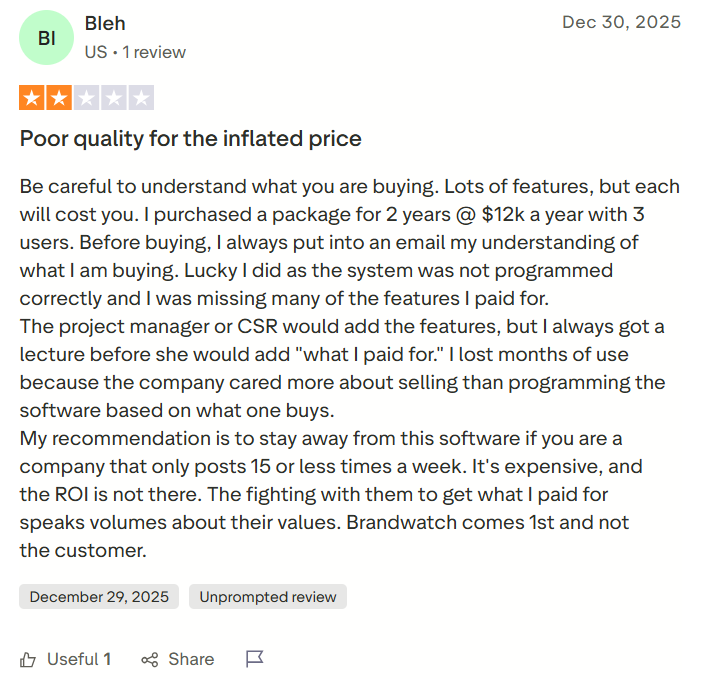
Trustpilot review of Brandwatch: a 2-year package at $12k a year for 3 users, not worth it for a company posting 15 or fewer times a week
Via Trustpilot

3. Sprinklr: Enterprise suite across care, marketing and social

Reddit post on Sprinklr pricing: Sprinklr Social at $2,800 per user a year on Growth and $4,700 on Enterprise, annual contracts only
Via Reddit

Sprinklr unifies customer care, marketing, research, and advertising across more than 30 channels, at probably one of the largest scales on this list. However, the customers Sprinklr is caring for at the moment are enterprises only, since it discontinued its Self-Serve tier in April 2026.

Sprinklr pricing

  • On the website: custom, enterprise-only. Implementation is quoted separately, and AI token costs run through your own OpenAI, Anthropic, Azure, Google, Amazon, or xAI key
  • From contract data: Vendr’s median is around $129,380 a year, while SpendHound reports an enterprise average near $606,905. That 5x gap tells you contracts vary enormously by module count, so no benchmark will predict your quote
  • A buyer breakdown puts Sprinklr Social at $2,800 per user per year on Growth and $4,700 on Enterprise, so a 10-person team pays $28,000 to $47,000 for the Social product alone before Insights, Marketing or Service are added
  • Worth knowing: reported minimums start around $50,000 a year, and auto-renewal needs 60 to 90 days' notice
  • Trial: none since Self-Serve ended

Everything in one platform, if you need everything

  • Genuinely unified across care, marketing, research, and advertising
  • Managed services, which Anna P. called amazing, do work you would otherwise hire for
  • G2 reports 2-month implementation and 16-month ROI

Where another tool fits better

  • There is no entry point below roughly $50,000 a year anymore
  • A customer who has been using Sprinklr for five years pointed out limitations in its social listening features. If listening is your main priority, it's worth looking into these before buying
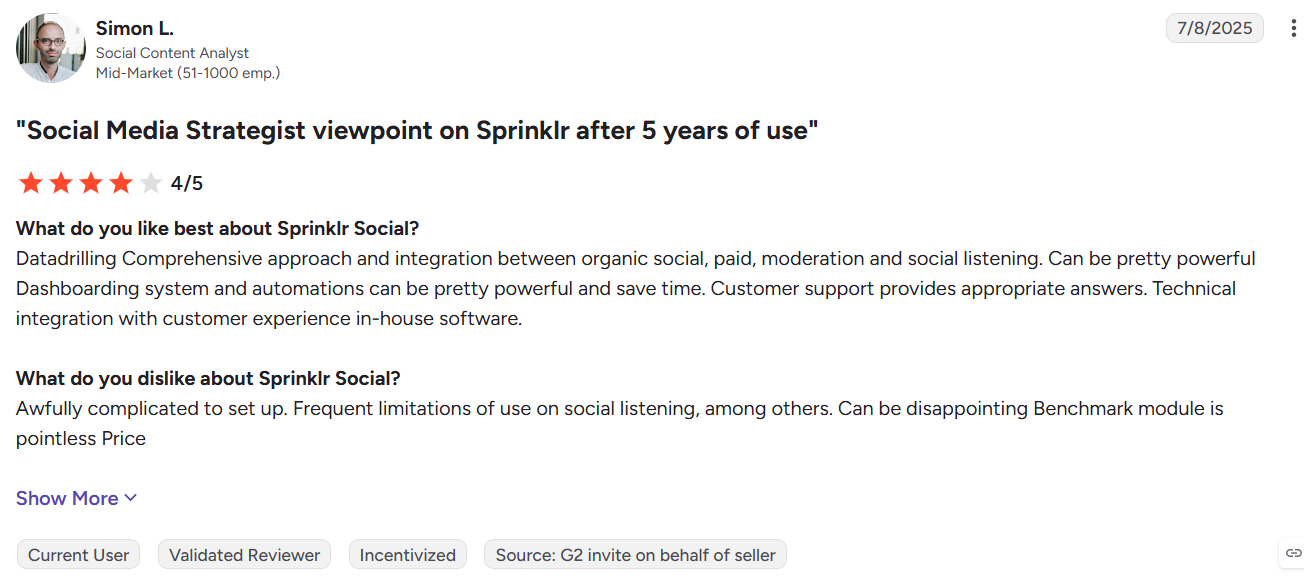
G2 review of Sprinklr Social from a 5-year user noting frequent limits in its social listening
Via G2

4. Meltwater: Broad media coverage for PR and comms teams

Reddit comment from a PR team that moved from Cision at about $23k a year to Meltwater at about $45k a year for 5 seats
Via Reddit

Meltwater covers an array of media types spanning print, broadcast, podcast, and a journalist database, alongside social. It is a favorite of communications and PR teams, to say the least. Capterra scores value for money at 3.7, and the common theme in reviews is the add-on structure rather than the platform itself.

Meltwater pricing

  • On the website: 4 quote-only tiers, Starter, Pro, Enterprise and Agency, with no figures attached
  • One buyer reported switching from Cision at about $23,000 a year to Meltwater at about $45,000 a year for 5 seats, with broadcast monitoring and the journalist database included, and called it overpriced while admitting it worked better
  • From contract data: Vendr’s median across 126 purchases is $25,800 a year with an average 13% discount
  • Trial: none

The broadest media coverage here

  • Print, broadcast, podcast and journalist database alongside social

Where another tool fits better

  • Price creep is the recurring theme. A mid-market reviewer said the cost keeps rising and the service packages contain features they do not use, which is pushing them to look elsewhere
  • Customers note social monitoring sits as an add-on rather than in the central service
  • Renewal increases of 3 to 7% are confirmed, and the cancellation window is 60 days, which several reviewers missed
G2 review of Meltwater: thorough media monitoring, but the price keeps creeping up
Via G2

5. Lumen by Talkwalker: Multilingual listening with image and audio recognition

Capterra review of Talkwalker saying the pricing module seems expensive next to competing tools
Via Capterra

Talkwalker was renamed Lumen by Talkwalker in June 2026 and now sits within Hootsuite Social OS, following Hootsuite’s acquisition in 2024. The name might have changed, but it still runs quite the show, covering 150 million sources across 187 languages, with image and audio recognition included in the product.

Lumen by Talkwalker pricing

  • On the website: custom; 3 quote-only tiers that scale on data volume. Core is the baseline, Analyze is 2x the volume plus 25 more topics and channels, Business is 6x with extra historical data
  • Worth knowing: Core’s base volume is described only as ideal for essential social listening
  • From contract data: Vendr’s median is around $13,300 a year, and G2’s estimate rests on just 6 purchases, so the benchmark here is weak
  • Trial: demo only

Unlimited users on every plan

  • Onboarding, training, regional support, and strategy reviews are included rather than invoiced
  • Image and audio recognition are in the product, not sold separately

Where another tool fits better

  • Facebook and Instagram listening is limited by platform API restrictions, sentiment needs manual correction, and there is no analysis of the profiles mentioning your keywords, so it is stronger for crisis tracking than for topic analysis
  • The volume allowance is the price lever, and it is not published, so the tiers are hard to compare without a quote
Capterra review of Talkwalker: Facebook and Instagram listening is limited and sentiment needs manual correction
Via Capterra

6. YouScan: Image analysis and TikTok coverage at scale

YouScan pricing page: Starter 3 at $499 a month billed annually, and Unlimited plans configured to your requirements

YouScan is known for its image analysis, particularly logo and product recognition, which reviewers often cite as the reason they chose it. And if you're wondering whether YouCan track TikTok conversations at scale, YouScan has strong coverage there too.

YouScan pricing

  • On the website: Starter 3 at $499 a month billed annually, covering 3 topics and up to 15,000 monthly mentions, with Insights Copilot capped at 10 questions a month. Unlimited plans are custom
  • Not included in Starter: Visual Insights, Audience Insights, unlimited Copilot questions, unlimited dashboards, data export and API access all sit in the Unlimited tier
  • Trial: yes, set up through a demo with an account configured for you

Enterprise capability

  • Unlimited users on every tier, so team size does not change the price
  • TikTok at scale, which reviewers repeatedly name as the deciding factor

Where another tool fits better

  • The image analysis YouScan is known for is in the Unlimited tier, not the published plan

Social listening tools pricing

7. Brand24: Published tiers for small and mid-sized teams

Brand24 pricing page: Individual $199, Team $299, Pro $399, Business $599 and Enterprise from $1,499 a month

Small and mid-sized teams tracking a brand (or 24 :P), a handful of competitors, and a category conversation can really make the most of Brand24. It also publishes every tier along with the keyword, mention, and refresh limits attached to each, so one can easily size a plan against their real volume.

Brand24 pricing

  • On the website: Individual $199 for 3 keywords and 2,000 mentions, Team $299 for 7 keywords and 10,000 mentions, Pro $399 for 12 keywords and 40,000, Business $599 for 25 keywords and 100,000, Enterprise from $1,499. Annual gets up to 3 months free
  • Not included: API costs $149 extra on Individual and Team
  • Worth knowing: that works out at over $99 per 1,000 mentions on Individual and about $6 on Business, so the entry plan is the expensive one per unit
  • Trial: 14 days, cancel any time

Every limit published before you pay

  • You can size the plan against actual mention volume rather than guessing
  • Unlimited users from the $299 tier up
  • Real-time refresh from $399

Where another tool fits better

  • Historical data caps at 1 year, as suggested by customers
  • The entry plan is poor value per mention, so most teams land at $399 or above
  • Boolean operators cannot be combined freely, which makes tuning hard if your brand uses common words
G2 review of Brand24 praising the AI insights report but calling the price a little steep
Via G2

8. Mention: Single-plan monitoring across social, web and review sites

Mention covers social platforms, web sources, and more than 75 review sites, including Google, Trustpilot, and Glassdoor, which is broad coverage for a mid-market tool. But what's worth mentioning is that it's now owned by Agorapulse and focuses entirely on monitoring and listening, with publishing and response features retired.

Mention pricing

  • Custom
  • Listed elsewhere: G2 and Capterra both show $599 a month as vendor-provided data

No tier decisions

  • Multi-user access, sentiment, competitor benchmarking and white-label reporting
  • 75+ review sites

Where another tool fits better

  • With no published price and no self-serve tier, you cannot size this without a sales conversation
  • Customers note the automatic renewal is not clearly flagged
G2 review of Mention: cost is a concern and the automatic renewal was not flagged
Via G2

9. Awario: High mention volume on a tight budget

Awario pricing page: Starter $49, Pro $149 and Enterprise $399 a month on monthly billing

Awario publishes 3 tiers with Boolean search on all of them, and progressively unlocks data export, reports, API, and an account manager as you move up. It suits teams needing high mention volume on a tight budget, especially across Reddit, X, and YouTube.

Awario pricing

  • On the website: Starter $49 for 3 topics and 30,000 mentions, Pro $149 for 15 topics and 300,000, Enterprise $399 for 100 topics, 1,000,000 mentions, and unlimited team members. Annual saves up to 40 percent
  • Read before signing: Awario’s own FAQ confirms no refunds for partial use or remaining subscription time
  • Trial: free Starter-level access, no credit card

Low cost per mention

  • API access, white-label reports and an account manager arrive at $399 a month with unlimited team members
  • Monthly billing available with no commitment

Where another tool fits better

  • One reviewer describes being auto-charged for a second year after a month of use, against that no-refund policy
  • Reviewers report sentiment needing manual correction and stats differing from the native platforms
G2 review of Awario from a user charged for a second year after a month of use, with no refund
Via G2

Social media management and monitoring tools pricing

10. Sprout Social: Publishing and reporting with listening as an add-on

Sprout Social pricing page: Standard $199, Professional $299 and Advanced $399 per seat a month, Enterprise custom, Essentials $79

Even though Sprout Social is a widely recognized social intelligence tool, it focuses primarily on publishing, a unified inbox, approvals, and reporting. It has many strengths, particularly in analytics and report design, but social listening is not included in the core product. That feature is added outside the standard plans as a separate module and is a guest you have to pay to invite.

Sprout Social pricing

  • On the website: Essentials $99, Standard $249, Professional $399, Advanced $499 per seat per month. Annual billing drops these to $79, $199, $299, and $399. Enterprise is custom
  • Not included: social listening, available from Standard up, with no published price. Sprout directs buyers to an account manager
  • Commonly cited elsewhere: around $999 a month for listening. Sprout has never confirmed it, and one trail leads back to an unsourced average, so treat it as a rough signal only
  • 30 day free trial, no credit card required

Everything is priced on a public page

  • You can model the bill yourself
  • The management side is genuinely strong: publishing, inbox, approvals, and reporting in one place

Where another tool fits better

  • Per seat compounds fast. 5 people on Advanced is $23,940 a year before listening is switched on
  • Cancellation is the recurring complaint. A Canadian VP left a 1-star review describing the process as a nightmare due to automatic renewal
Capterra review of Sprout Social calling the cancellation process a literal nightmare
Via Capterra

11. Hootsuite: Multi-account scheduling with published per-seat pricing

Hootsuite pricing page: Standard $99, Professional $199 and Advanced $399 per user a month, Enterprise custom

Hootsuite publishes its prices clearly, which makes it one of the easiest tools to budget for. Scheduling, the unified inbox, and multi-account management are what it does best. But what may not be so Hoot is that social listening comes through Lumen, with only a limited version available in the published tiers. The fuller capability sits in Enterprise or comes as an add-on.

Hootsuite pricing

  • On the website: Standard $99, Professional $199, Advanced $399 per seat per month on annual billing, plus custom Enterprise. The free plan was discontinued in 2026
  • Not included: sentiment analysis, image recognition, 13-month historical data, advanced sources, and trend forecasting are all Enterprise-only, and full Lumen is a separate add-on again
  • Worth knowing: AI credits cap at 100 a month on every published tier, regardless of what you pay
  • Trial: free, no credit card

Generous account limits

  • Unlimited social accounts from $199, better than most per-seat competitors
  • Very easy to deploy

Where another tool fits better

  • The capabilities an insights team or a social media team needs sit in Enterprise, so listening buyers end up in a custom quote regardless
G2 review of Hootsuite: as the business grows you pay more for features you did not expect to need
Via G2

12. Agorapulse: Entry-level publishing and inbox for small teams

Agorapulse pricing page: Standard $79, Professional $119 and Advanced $149 per user a month, plus a Custom plan

Agorapulse is usually more helpful for small and mid-sized teams and agencies. The inbox, publishing, and approval workflows are straightforward. But what might send you into a loop of conversations with the sales team is social listening, because it's only available as an Advanced Listening add-on.

Agorapulse pricing

  • On the website: Free for 1 user and 3 profiles, then Standard $79, Professional $119, Advanced $149 per user per month, plus Custom. Annual saves about 20%. 10 profiles on every paid tier; extras at $10 each
  • Not included: Advanced Listening, Competitive Benchmarking, Advocacy, and X access are all add-ons with no published price
  • Worth knowing: nonprofits get 20% off for the life of the account
  • Trial: 30 days, no credit card.

The gentlest entry point here

  • A free tier that is genuinely usable rather than a demo in disguise
  • Highest ease-of-use scores in this guide, which shows in onboarding time
  • The per-user price stays low even on the top published tier

Where another tool fits better

  • Listening is unpriced, so the page price is not the final price
  • Multi-step approvals need the Custom plan rather than Professional, which catches teams out at renewal
Capterra review of Agorapulse: good value for a small company, but the full reports cost extra
Via Capterra

13. BuzzSumo: Content and PR research with bundled users

BuzzSumo pricing page: Content Creation $199, PR and Comms $299, Suite $499 and Enterprise $999 a month

BuzzSumo is a content and PR research tool from Cision, the same parent as Brandwatch. Its index is the main asset, covering over 300 trillion engagements and 8 billion articles, which is why it surfaces content and links faster than most alternatives.

BuzzSumo pricing

  • On the website: Content Creation $199 for 1 user and 2 alerts, PR and Comms $299 for 5 users and 5 alerts, Suite $499 for 10 users and 10 alerts, Enterprise $999 for 30 users and 50 alerts. Searches are unlimited on all tiers and annual saves 20 percent
  • Not included: both the Account API and Search API are quoted separately
  • Worth knowing: cancel early and you still pay the full term, confirmed in BuzzSumo’s own FAQ
  • Trial: 30 days

Users bundled rather than charged per seat

  • 30 users on Enterprise works out at $33 each
  • Reviewers consistently say it surfaces links and content faster than alternatives

Where another tool fits better

  • Alerts are the binding limit, so 2 at $199 pushes most teams straight to $299
  • API has no published price, so a data-led team cannot budget it from the page
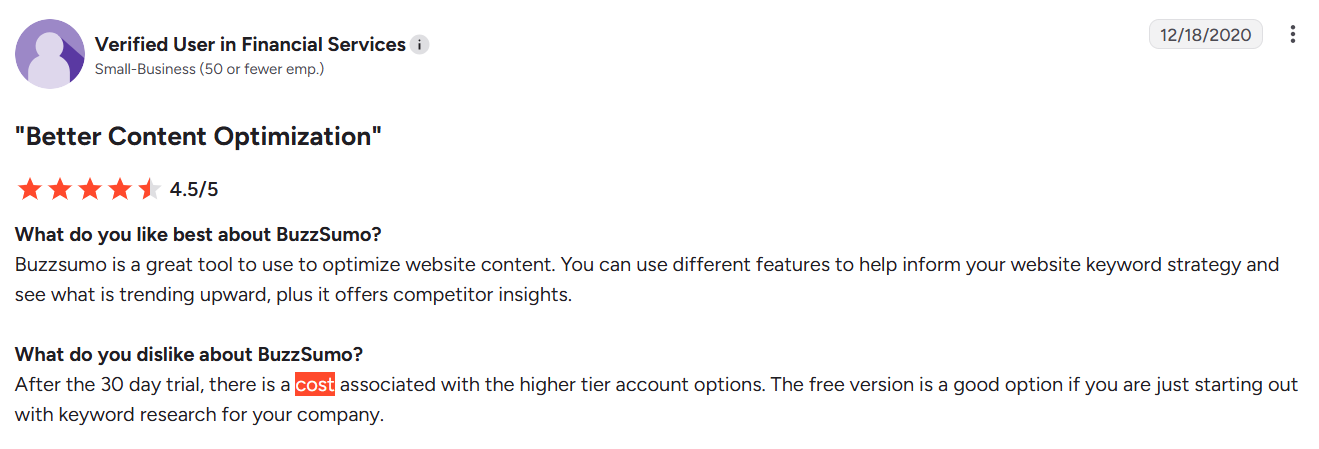
G2 review of BuzzSumo noting a cost for the higher-tier accounts after the 30-day trial
Via G2

14. Keyhole: Campaign and hashtag measurement for agencies

Keyhole is a campaign and hashtag measurement tool with influencer analytics attached, and most of its users buy it in bursts rather than annually. But here's the key thing to remember: reviews note that it gets expensive fast if a campaign really takes off, because the data allowance gets eaten up, and tracking either stops or the cost climbs.

Keyhole pricing

  • 2 plans, neither published
  • Team: 10 profiles, 5 listening topics, 10,000 posts, 3 users, PDF and XLS reports
  • Enterprise: 15+ profiles, 15+ topics, 20,000 posts, 10+ users, plus influencer analysis, competitor benchmarking, white-labelled dashboards, historical data and invoice billing
  • Third-party estimates run from $79 to $179 a month
  • Historical data sits in Enterprise only
  • Trial: Yes, though reviewers report being routed to a consultation first

Clean reporting that clients can read

  • Users bundled into the plan rather than charged per seat

Where another tool fits better

  • Post caps mean a campaign that overperforms either stops being tracked or costs more
  • Trackers need to be in place before a campaign starts
G2 review of Keyhole: the cost-to-benefit ratio is hard to justify for small and mid-sized clients
Via G2

How consumer brands evaluate a social intelligence platform, and what moves the price

One thing that will come up in this guide over and over again is that no social intelligence platform publishes its prices. This is definitely not a buyer-friendly practice. Then why exactly are these platforms approaching budgeting this way?

The important thing to understand here is that instead of asking how much a tool costs, brands are focusing more on the variables they need and how much these factors increase the cost of their plan.

In 2026, insights and digital strategy teams specifically are looking at four requirements, and all of them directly tie to a line in a quote.

1. Speed has become a recurring priority

Sprout Social’s 2026 Social Intelligence Report, a survey of professionals across the US, UK, and Australia, found that 93% consider social intelligence essential to future growth, while only 10% can turn a real-time insight into action within hours.

2. Video is the majority of our feeds

Short-form video accounts for 58% of all time spent on social media worldwide. In fact, short-form video is the most engaged brand content format on Instagram at 52%, YouTube at 52%, and Facebook at 48%. A platform that reads captions and transcripts but not spoken audio, on-screen text, or objects in frame is analysing only a minority of the format.

3. Creator verification, because the spend is large and the measurement is weak

The Association of National Advertisers reports that roughly 29% of influencer marketing budgets are wasted on fraudulent followers, unverifiable engagement, or content that never reaches the target audience.

4. Integrations become transparency

Excerpt from Adobe's Digital Trends report: only 39% of organizations have a unified customer data foundation

Marketing is heavily influenced by social data, for obvious reasons. But only 39% of organisations have a unified customer data foundation. So, mention sits in one place that is usually very far away from sales figures. That leaves 61% of organizations likely paying people to export this data and stitch it together in spreadsheets by hand. When automation becomes an active conversation, brands are focusing on API access, integrations, and data export. Many entry tiers, however, leave out these variables.

Two example brands: published plans vs a custom quote

Let's try to understand how this list of priorities applies in real life to two kinds of brands.

Brand ABrand B
BusinessSmaller consumer brandLarge multinational brand
Products1 product line9 sub-brands and 60 SKUs
MarketsUS only14 markets
LanguagesEnglish11 languages
Conversations monitored40,000/month2 million/month
People using the software230
Historical data12 months36 months
Additional requirementsBasic monitoringVideo analysis and API integration

Based on the publicly available pricing we've discussed so far, we estimate Brand A might pay a minimum of $1,788 and a maximum of $7,188 a year.

ToolPlan that fitsAnnual cost
AwarioPro$1,788
Brand24Pro$4,788
Sprout SocialStandard, 2 seats$4,776 before listening
MentionCompany planAbout $7,188

Most of these publicly listed plans are designed around specific limits on mentions, users, historical data, and available features. Brand B's requirements go well beyond those limits.

This is where custom pricing starts to make sense. Instead of choosing a plan and then figuring out how to work around its limitations, Brand B can approach a vendor with its exact requirements: 2 million monthly mentions, 30 users, 14 markets, 11 languages, and three years of historical data, alongside video analysis and API access.

The vendor can then build a quote around those requirements, specifying what is included, what costs extra, and where any limitations remain.

Now, Brand B might still have to pay a massive chunk of its budget to this vendor. But the company can at least evaluate the cost of a solution designed for its actual needs, rather than comparing subscription prices that don't cover the same scope.

How to evaluate a social intelligence contract before you sign

Most of the unpleasant surprises in this category are about what parameters the headline price did not include. If you cross your mention cap during a campaign, what's next? The middle of a campaign is not a good time to figure that out.

This scenario (along with a hundred more) is avoidable, and all of it comes down to asking 6 things before signing rather than after.

Checklist of 6 questions to ask before you sign: which modules are included, what are my usage limits, how far back does history go, how do I get my data out, what do onboarding and services cost, and what are the renewal terms

Why is Clayface the right social intelligence tool for you?

A lot of our discussion in this guide has revolved around the four things insights teams are looking for: speed, video intelligence, creator-level truth, and data that joins up.

Instead of trying to fit these capabilities into an existing product, they're at the core of what Clayface does. It captures the whole conversation, including what is said in a video, what appears as on-screen text, and which products are visible in the frame.

For example, a creator posts a get-ready-with-me video. The caption reads “my everyday routine” and never names the brand. She says out loud at 0:42 that the medium shade is way too pink on her, holds the bottle up to the camera, and the shade number is burned into the on-screen text.

How Clayface reads one TikTok: spoken audio, on-screen text and the product in frame are matched to the brand's own ontology (Foundation, shade 320), then to creator and feature level, giving a figure you can defend

Clayface reads 3 signals from the same clip, resolves them to Foundation shade 320 using the brand’s own product hierarchy rather than a vendor category tree, attributes it to a specific creator with a verified audience, and classifies it at feature level as a shade accuracy complaint rather than a negative mention of the product overall.

Of course, you don't have to take our word for it. Run Clayface alongside the tool you're already using for 2 weeks, tracking your brand and competitors, and experience how empowering a consolidated dashboard feels.

Request a demo or talk to us first to discuss the scope.

How Much Do Social Intelligence Tools Cost? A Full Pricing Breakdown

Social listening tools pricing in 2026 ranges from $49 a month to over $100k a year. Compare 14 tools like Clayface, Brandwatch, Sprinklr and Meltwater.

Ronak Shah
Ronak Shah
October 15, 2026
Published:
October 15, 2026
Updated:
How Much Do Social Intelligence Tools Cost? A Full Pricing Breakdown

Summarize this article with AI

Table of Contents

TL;DR

  • Social intelligence tools pricing in 2026 runs from $30/month to $100k+/year, depending on listening or advanced capabilities.
  • Clayface (custom pricing) reads video, including spoken audio, and joins what it finds to your own product hierarchy and retail data.
  • Paid plans start at $49 a month for Awario, $79 per user for Agorapulse, $99 per seat for Hootsuite, and $199 for Brand24.
  • Vendr contract data puts the Brandwatch average at $58,000 a year, and the Meltwater and Sprinklr medians at $25,800 and $129,380.
  • Based on public pricing, tracking 40,000 mentions a month with 2 users costs about $1,788 to $7,188 a year.

Most articles discussing social intelligence tools end up grouping social media monitoring, social listening, and social media management platforms together. Sure, these tools overlap in what they offer, but their pricing is proof that they don't do the same job.

Social media monitoring tools range from $30 to $300 per month, with pricing that scales with usage. Social listening tools can cost upwards of $500 per month.

The pricing model for these platforms also changes dramatically depending on the buyer. For SMBs and mid-market companies, vendors typically offer fixed, predictable pricing, with additional fees kicking in when necessary.

However, when selling to enterprise accounts or fast-growing consumer brands, usage can fluctuate significantly. Because so many variables influence scale, such as query volume, historical data needs, and seat counts, vendors often avoid publishing fixed enterprise price lists. Instead, they opt for custom annual contracts for each deployment.

While enterprise platforms rarely disclose actual contract values, Vendr, a procurement marketplace, records what its customers actually pay. According to its data, the average Brandwatch contract is about $58,000/year, while Talkwalker and Meltwater’s median prices are $13,300/year and $25,800/year, respectively.

Diagram: social media monitoring ($30 to $300 a month) sits inside social listening (from about $500 a month), which sits inside social intelligence (custom quotes, $25,000 to $130,000 a year)

To give you a complete picture of how these tools are priced and what you get for your buck, we did our own window shopping. The information in this pricing guide draws on our experience, customer reviews, conversations about these tools amongst buyers, insights from industry experts, and market research.

Top Social Intelligence tools: Pricing compared

ToolTypePricing (plans monthly, contracts yearly)Free trialTop capabilities
ClayfaceSocial intelligenceCustom, scoped to volume and use cases14-day free trial, no credit cardVideo, creator, digital shelf, and brand intelligence joined to your own data
BrandwatchSocial intelligenceCustom, $10,000 to $81,200 a year
Vendr averages $58,000 across 40 contracts
A Trustpilot buyer reports $12,000 for 3 users
A Reddit agency $10,000 for 2 seats
NoEnterprise consumer intelligence and historical archive
SprinklrSocial intelligenceCustom
$28,000 to $130,000 a year
Vendr median $129,380
A Reddit breakdown puts Social alone at $2,800 per user per year, so $28,000 for 10 users
NoUnified customer experience suite across 30+ channels
MeltwaterSocial intelligenceCustom
$23,000 to $45,000 a year
Vendr median $25,800 across 126 contracts
A Reddit buyer reports $45,000 for 5 seats with broadcast and journalist database
NoMedia monitoring and PR, listening sold alongside
Lumen by TalkwalkerSocial intelligenceCustom (3 tiers)
Around $13,300 a year
Demo onlyListening and media monitoring with image and audio recognition
YouScanSocial intelligence$499 Starter 3, Unlimited customYes, demo-ledVisual listening and image analysis at scale
Brand24Social listening$199 / $299 / $399 / $599, Enterprise from $1,49914 daysMention tracking and sentiment for small and mid teams
MentionSocial listeningFrom $599, annual only14 daysMention tracking across social, web, and 75+ review sites
AwarioSocial listening$49 / $149 / $399Yes, no cardHigh-volume mention monitoring at the lowest cost per mention
Sprout SocialManagement with listening$99 to $499 per seat, listening add-on about $99930 days, no cardPublishing, inbox and analytics, listening bolted on
HootsuiteManagement with listening$99 / $199 / $399 per seat, Enterprise customYes, no cardPublishing and inbox, Lumen listening gated to Enterprise
AgorapulseManagement with listeningFree, then $79 / $119 / $149 per user, Custom30 days, no cardPublishing, inbox and approvals, listening as an add-on
BuzzSumoContent and PR research$199 / $299 / $499 / $99930 daysContent research, trends and journalist database
KeyholeCampaign analyticsCustom (2 plans)YesHashtag, campaign and influencer measurement

Social intelligence tools pricing

1. Clayface: Best overall Social Intelligence platform

Clayface campaign dashboard with total reach, total engagement, engagement rate, audience themes, sentiment bars and comment counts

Disclosure: Clayface is our product, and we've included it in this comparison. We'll show where it fits, which use cases it's designed for, and where it may not be the right choice.

Clayface is a social intelligence platform built on creator data infrastructure that its parent company, Phyllo, spent years developing. That lineage is why it reads video frame-by-frame and sustainably measures creators.

Let's say a product’s rating drops on one retailer over 6 weeks. Socials are seemingly normal at a brand level, and your listening tools are currently not reporting any change in sentiment. But what actually happened was that a supplier switched the pump mechanism. In captions or review titles, this never actually showed up. But where it did come up was during unboxing videos, where creators said out loud that the new pump dispenses way too much of the product. The comments underneath also continue to talk about this problem.

What Clayface does differently that actually makes a difference for you is that it reads the spoken audio. It even translates the language if needed, matches it to the specific SKU using your product hierarchy rather than its own, and lines it up against digital shelf data, the retailer review data, and the date the new stock shipped.

Clayface pricing

  • Custom, scoped to your volume and use cases, with no per-seat component, so a 12-person team costs what a 2-person team does. You get a figure in the first conversation
  • 14-day free trial, no credit card

Turning social conversations into source-backed business insights

  • Spoken audio, on-screen text, and objects in frame. A brand that lives on TikTok finds out what people actually said about the product, including the complaint nobody typed
  • Creator-level truth. Verified audience against claimed audience, cross-platform identity, fraud scoring, and attribution back to conversion
  • Ratings, listings, and reviews across every retailer you sell through, sitting next to the social data rather than in a separate tool. Example: One retailer connected internal returns to reviews across retailers and social, and cut returns by 5%
  • Competitive intelligence. Track your competitors' products, campaigns, and conversations alongside your own, so you can see where they're gaining attention and how your brand compares.
  • Get ahead of developing trends and understand which conversations are gaining momentum and which are fading.
  • Clayface works with your existing product taxonomy, so you can analyse conversations at the brand, product, and feature level without manually reorganising everything.
  • Findings come with their underlying sources, while recurring reports keep the analysis updated. Perfect for building reports you can easily defend.

Where another tool fits better

  • Clayface doesn't schedule posts or reply to comments, so you'll still pay for a publishing tool such as Sprout Social, Hootsuite, or Agorapulse alongside it
  • Clayface focuses on digital data, so it won't tell you what's happening on physical store shelves
  • We don't publish fixed pricing plans, so you'll need to speak with our team to discuss your goals and get a custom quote

2. Brandwatch: Deep historical archive for research teams

G2 review of Brandwatch saying the higher-end cost could be a barrier and that billing was hard to untangle
Via G2

Brandwatch is very popular in the consumer intelligence category, particularly celebrated for its historical archive depth and Boolean query power. Research teams use it for longitudinal analysis or complex segmentation.

However, Brandwatch is sold as separate products, with Consumer Intelligence, Social Media Management, and Influencer Marketing quoted individually. It's worth mapping out exactly what you need before having that sales conversation, or your budget might become history too (pun intended).

Brandwatch pricing

  • On the website: Custom
  • From contract data: Vendr, which publishes figures from deals it has negotiated, reports an average of $58,000 a year across 40 purchases, a median near $50,000, and an average discount of 15.29%
  • Worth knowing: Brandwatch’s fiscal year ends in December, so quarter-ends carry more flexibility
  • Trial: none

The deepest archive in the category

  • Historical data and query power the lighter tools cannot match
  • Real contract data exists, so you walk in knowing roughly what good looks like

Where another tool fits better

  • Small configurations are where the value breaks down. A Trustpilot reviewer paying $12,000 a year for 3 users said the ROI is not there if you post 15 or fewer times a week, and a marketing agency on $10,000 a year for 2 seats went looking for a cheaper option while admitting they had no real complaints about the product
  • Video coverage has not kept pace, so test it against your channel mix
  • Auto-renewal appears in several complaints
Trustpilot review of Brandwatch: a 2-year package at $12k a year for 3 users, not worth it for a company posting 15 or fewer times a week
Via Trustpilot

3. Sprinklr: Enterprise suite across care, marketing and social

Reddit post on Sprinklr pricing: Sprinklr Social at $2,800 per user a year on Growth and $4,700 on Enterprise, annual contracts only
Via Reddit

Sprinklr unifies customer care, marketing, research, and advertising across more than 30 channels, at probably one of the largest scales on this list. However, the customers Sprinklr is caring for at the moment are enterprises only, since it discontinued its Self-Serve tier in April 2026.

Sprinklr pricing

  • On the website: custom, enterprise-only. Implementation is quoted separately, and AI token costs run through your own OpenAI, Anthropic, Azure, Google, Amazon, or xAI key
  • From contract data: Vendr’s median is around $129,380 a year, while SpendHound reports an enterprise average near $606,905. That 5x gap tells you contracts vary enormously by module count, so no benchmark will predict your quote
  • A buyer breakdown puts Sprinklr Social at $2,800 per user per year on Growth and $4,700 on Enterprise, so a 10-person team pays $28,000 to $47,000 for the Social product alone before Insights, Marketing or Service are added
  • Worth knowing: reported minimums start around $50,000 a year, and auto-renewal needs 60 to 90 days' notice
  • Trial: none since Self-Serve ended

Everything in one platform, if you need everything

  • Genuinely unified across care, marketing, research, and advertising
  • Managed services, which Anna P. called amazing, do work you would otherwise hire for
  • G2 reports 2-month implementation and 16-month ROI

Where another tool fits better

  • There is no entry point below roughly $50,000 a year anymore
  • A customer who has been using Sprinklr for five years pointed out limitations in its social listening features. If listening is your main priority, it's worth looking into these before buying
G2 review of Sprinklr Social from a 5-year user noting frequent limits in its social listening
Via G2

4. Meltwater: Broad media coverage for PR and comms teams

Reddit comment from a PR team that moved from Cision at about $23k a year to Meltwater at about $45k a year for 5 seats
Via Reddit

Meltwater covers an array of media types spanning print, broadcast, podcast, and a journalist database, alongside social. It is a favorite of communications and PR teams, to say the least. Capterra scores value for money at 3.7, and the common theme in reviews is the add-on structure rather than the platform itself.

Meltwater pricing

  • On the website: 4 quote-only tiers, Starter, Pro, Enterprise and Agency, with no figures attached
  • One buyer reported switching from Cision at about $23,000 a year to Meltwater at about $45,000 a year for 5 seats, with broadcast monitoring and the journalist database included, and called it overpriced while admitting it worked better
  • From contract data: Vendr’s median across 126 purchases is $25,800 a year with an average 13% discount
  • Trial: none

The broadest media coverage here

  • Print, broadcast, podcast and journalist database alongside social

Where another tool fits better

  • Price creep is the recurring theme. A mid-market reviewer said the cost keeps rising and the service packages contain features they do not use, which is pushing them to look elsewhere
  • Customers note social monitoring sits as an add-on rather than in the central service
  • Renewal increases of 3 to 7% are confirmed, and the cancellation window is 60 days, which several reviewers missed
G2 review of Meltwater: thorough media monitoring, but the price keeps creeping up
Via G2

5. Lumen by Talkwalker: Multilingual listening with image and audio recognition

Capterra review of Talkwalker saying the pricing module seems expensive next to competing tools
Via Capterra

Talkwalker was renamed Lumen by Talkwalker in June 2026 and now sits within Hootsuite Social OS, following Hootsuite’s acquisition in 2024. The name might have changed, but it still runs quite the show, covering 150 million sources across 187 languages, with image and audio recognition included in the product.

Lumen by Talkwalker pricing

  • On the website: custom; 3 quote-only tiers that scale on data volume. Core is the baseline, Analyze is 2x the volume plus 25 more topics and channels, Business is 6x with extra historical data
  • Worth knowing: Core’s base volume is described only as ideal for essential social listening
  • From contract data: Vendr’s median is around $13,300 a year, and G2’s estimate rests on just 6 purchases, so the benchmark here is weak
  • Trial: demo only

Unlimited users on every plan

  • Onboarding, training, regional support, and strategy reviews are included rather than invoiced
  • Image and audio recognition are in the product, not sold separately

Where another tool fits better

  • Facebook and Instagram listening is limited by platform API restrictions, sentiment needs manual correction, and there is no analysis of the profiles mentioning your keywords, so it is stronger for crisis tracking than for topic analysis
  • The volume allowance is the price lever, and it is not published, so the tiers are hard to compare without a quote
Capterra review of Talkwalker: Facebook and Instagram listening is limited and sentiment needs manual correction
Via Capterra

6. YouScan: Image analysis and TikTok coverage at scale

YouScan pricing page: Starter 3 at $499 a month billed annually, and Unlimited plans configured to your requirements

YouScan is known for its image analysis, particularly logo and product recognition, which reviewers often cite as the reason they chose it. And if you're wondering whether YouCan track TikTok conversations at scale, YouScan has strong coverage there too.

YouScan pricing

  • On the website: Starter 3 at $499 a month billed annually, covering 3 topics and up to 15,000 monthly mentions, with Insights Copilot capped at 10 questions a month. Unlimited plans are custom
  • Not included in Starter: Visual Insights, Audience Insights, unlimited Copilot questions, unlimited dashboards, data export and API access all sit in the Unlimited tier
  • Trial: yes, set up through a demo with an account configured for you

Enterprise capability

  • Unlimited users on every tier, so team size does not change the price
  • TikTok at scale, which reviewers repeatedly name as the deciding factor

Where another tool fits better

  • The image analysis YouScan is known for is in the Unlimited tier, not the published plan

Social listening tools pricing

7. Brand24: Published tiers for small and mid-sized teams

Brand24 pricing page: Individual $199, Team $299, Pro $399, Business $599 and Enterprise from $1,499 a month

Small and mid-sized teams tracking a brand (or 24 :P), a handful of competitors, and a category conversation can really make the most of Brand24. It also publishes every tier along with the keyword, mention, and refresh limits attached to each, so one can easily size a plan against their real volume.

Brand24 pricing

  • On the website: Individual $199 for 3 keywords and 2,000 mentions, Team $299 for 7 keywords and 10,000 mentions, Pro $399 for 12 keywords and 40,000, Business $599 for 25 keywords and 100,000, Enterprise from $1,499. Annual gets up to 3 months free
  • Not included: API costs $149 extra on Individual and Team
  • Worth knowing: that works out at over $99 per 1,000 mentions on Individual and about $6 on Business, so the entry plan is the expensive one per unit
  • Trial: 14 days, cancel any time

Every limit published before you pay

  • You can size the plan against actual mention volume rather than guessing
  • Unlimited users from the $299 tier up
  • Real-time refresh from $399

Where another tool fits better

  • Historical data caps at 1 year, as suggested by customers
  • The entry plan is poor value per mention, so most teams land at $399 or above
  • Boolean operators cannot be combined freely, which makes tuning hard if your brand uses common words
G2 review of Brand24 praising the AI insights report but calling the price a little steep
Via G2

8. Mention: Single-plan monitoring across social, web and review sites

Mention covers social platforms, web sources, and more than 75 review sites, including Google, Trustpilot, and Glassdoor, which is broad coverage for a mid-market tool. But what's worth mentioning is that it's now owned by Agorapulse and focuses entirely on monitoring and listening, with publishing and response features retired.

Mention pricing

  • Custom
  • Listed elsewhere: G2 and Capterra both show $599 a month as vendor-provided data

No tier decisions

  • Multi-user access, sentiment, competitor benchmarking and white-label reporting
  • 75+ review sites

Where another tool fits better

  • With no published price and no self-serve tier, you cannot size this without a sales conversation
  • Customers note the automatic renewal is not clearly flagged
G2 review of Mention: cost is a concern and the automatic renewal was not flagged
Via G2

9. Awario: High mention volume on a tight budget

Awario pricing page: Starter $49, Pro $149 and Enterprise $399 a month on monthly billing

Awario publishes 3 tiers with Boolean search on all of them, and progressively unlocks data export, reports, API, and an account manager as you move up. It suits teams needing high mention volume on a tight budget, especially across Reddit, X, and YouTube.

Awario pricing

  • On the website: Starter $49 for 3 topics and 30,000 mentions, Pro $149 for 15 topics and 300,000, Enterprise $399 for 100 topics, 1,000,000 mentions, and unlimited team members. Annual saves up to 40 percent
  • Read before signing: Awario’s own FAQ confirms no refunds for partial use or remaining subscription time
  • Trial: free Starter-level access, no credit card

Low cost per mention

  • API access, white-label reports and an account manager arrive at $399 a month with unlimited team members
  • Monthly billing available with no commitment

Where another tool fits better

  • One reviewer describes being auto-charged for a second year after a month of use, against that no-refund policy
  • Reviewers report sentiment needing manual correction and stats differing from the native platforms
G2 review of Awario from a user charged for a second year after a month of use, with no refund
Via G2

Social media management and monitoring tools pricing

10. Sprout Social: Publishing and reporting with listening as an add-on

Sprout Social pricing page: Standard $199, Professional $299 and Advanced $399 per seat a month, Enterprise custom, Essentials $79

Even though Sprout Social is a widely recognized social intelligence tool, it focuses primarily on publishing, a unified inbox, approvals, and reporting. It has many strengths, particularly in analytics and report design, but social listening is not included in the core product. That feature is added outside the standard plans as a separate module and is a guest you have to pay to invite.

Sprout Social pricing

  • On the website: Essentials $99, Standard $249, Professional $399, Advanced $499 per seat per month. Annual billing drops these to $79, $199, $299, and $399. Enterprise is custom
  • Not included: social listening, available from Standard up, with no published price. Sprout directs buyers to an account manager
  • Commonly cited elsewhere: around $999 a month for listening. Sprout has never confirmed it, and one trail leads back to an unsourced average, so treat it as a rough signal only
  • 30 day free trial, no credit card required

Everything is priced on a public page

  • You can model the bill yourself
  • The management side is genuinely strong: publishing, inbox, approvals, and reporting in one place

Where another tool fits better

  • Per seat compounds fast. 5 people on Advanced is $23,940 a year before listening is switched on
  • Cancellation is the recurring complaint. A Canadian VP left a 1-star review describing the process as a nightmare due to automatic renewal
Capterra review of Sprout Social calling the cancellation process a literal nightmare
Via Capterra

11. Hootsuite: Multi-account scheduling with published per-seat pricing

Hootsuite pricing page: Standard $99, Professional $199 and Advanced $399 per user a month, Enterprise custom

Hootsuite publishes its prices clearly, which makes it one of the easiest tools to budget for. Scheduling, the unified inbox, and multi-account management are what it does best. But what may not be so Hoot is that social listening comes through Lumen, with only a limited version available in the published tiers. The fuller capability sits in Enterprise or comes as an add-on.

Hootsuite pricing

  • On the website: Standard $99, Professional $199, Advanced $399 per seat per month on annual billing, plus custom Enterprise. The free plan was discontinued in 2026
  • Not included: sentiment analysis, image recognition, 13-month historical data, advanced sources, and trend forecasting are all Enterprise-only, and full Lumen is a separate add-on again
  • Worth knowing: AI credits cap at 100 a month on every published tier, regardless of what you pay
  • Trial: free, no credit card

Generous account limits

  • Unlimited social accounts from $199, better than most per-seat competitors
  • Very easy to deploy

Where another tool fits better

  • The capabilities an insights team or a social media team needs sit in Enterprise, so listening buyers end up in a custom quote regardless
G2 review of Hootsuite: as the business grows you pay more for features you did not expect to need
Via G2

12. Agorapulse: Entry-level publishing and inbox for small teams

Agorapulse pricing page: Standard $79, Professional $119 and Advanced $149 per user a month, plus a Custom plan

Agorapulse is usually more helpful for small and mid-sized teams and agencies. The inbox, publishing, and approval workflows are straightforward. But what might send you into a loop of conversations with the sales team is social listening, because it's only available as an Advanced Listening add-on.

Agorapulse pricing

  • On the website: Free for 1 user and 3 profiles, then Standard $79, Professional $119, Advanced $149 per user per month, plus Custom. Annual saves about 20%. 10 profiles on every paid tier; extras at $10 each
  • Not included: Advanced Listening, Competitive Benchmarking, Advocacy, and X access are all add-ons with no published price
  • Worth knowing: nonprofits get 20% off for the life of the account
  • Trial: 30 days, no credit card.

The gentlest entry point here

  • A free tier that is genuinely usable rather than a demo in disguise
  • Highest ease-of-use scores in this guide, which shows in onboarding time
  • The per-user price stays low even on the top published tier

Where another tool fits better

  • Listening is unpriced, so the page price is not the final price
  • Multi-step approvals need the Custom plan rather than Professional, which catches teams out at renewal
Capterra review of Agorapulse: good value for a small company, but the full reports cost extra
Via Capterra

13. BuzzSumo: Content and PR research with bundled users

BuzzSumo pricing page: Content Creation $199, PR and Comms $299, Suite $499 and Enterprise $999 a month

BuzzSumo is a content and PR research tool from Cision, the same parent as Brandwatch. Its index is the main asset, covering over 300 trillion engagements and 8 billion articles, which is why it surfaces content and links faster than most alternatives.

BuzzSumo pricing

  • On the website: Content Creation $199 for 1 user and 2 alerts, PR and Comms $299 for 5 users and 5 alerts, Suite $499 for 10 users and 10 alerts, Enterprise $999 for 30 users and 50 alerts. Searches are unlimited on all tiers and annual saves 20 percent
  • Not included: both the Account API and Search API are quoted separately
  • Worth knowing: cancel early and you still pay the full term, confirmed in BuzzSumo’s own FAQ
  • Trial: 30 days

Users bundled rather than charged per seat

  • 30 users on Enterprise works out at $33 each
  • Reviewers consistently say it surfaces links and content faster than alternatives

Where another tool fits better

  • Alerts are the binding limit, so 2 at $199 pushes most teams straight to $299
  • API has no published price, so a data-led team cannot budget it from the page
G2 review of BuzzSumo noting a cost for the higher-tier accounts after the 30-day trial
Via G2

14. Keyhole: Campaign and hashtag measurement for agencies

Keyhole is a campaign and hashtag measurement tool with influencer analytics attached, and most of its users buy it in bursts rather than annually. But here's the key thing to remember: reviews note that it gets expensive fast if a campaign really takes off, because the data allowance gets eaten up, and tracking either stops or the cost climbs.

Keyhole pricing

  • 2 plans, neither published
  • Team: 10 profiles, 5 listening topics, 10,000 posts, 3 users, PDF and XLS reports
  • Enterprise: 15+ profiles, 15+ topics, 20,000 posts, 10+ users, plus influencer analysis, competitor benchmarking, white-labelled dashboards, historical data and invoice billing
  • Third-party estimates run from $79 to $179 a month
  • Historical data sits in Enterprise only
  • Trial: Yes, though reviewers report being routed to a consultation first

Clean reporting that clients can read

  • Users bundled into the plan rather than charged per seat

Where another tool fits better

  • Post caps mean a campaign that overperforms either stops being tracked or costs more
  • Trackers need to be in place before a campaign starts
G2 review of Keyhole: the cost-to-benefit ratio is hard to justify for small and mid-sized clients
Via G2

How consumer brands evaluate a social intelligence platform, and what moves the price

One thing that will come up in this guide over and over again is that no social intelligence platform publishes its prices. This is definitely not a buyer-friendly practice. Then why exactly are these platforms approaching budgeting this way?

The important thing to understand here is that instead of asking how much a tool costs, brands are focusing more on the variables they need and how much these factors increase the cost of their plan.

In 2026, insights and digital strategy teams specifically are looking at four requirements, and all of them directly tie to a line in a quote.

1. Speed has become a recurring priority

Sprout Social’s 2026 Social Intelligence Report, a survey of professionals across the US, UK, and Australia, found that 93% consider social intelligence essential to future growth, while only 10% can turn a real-time insight into action within hours.

2. Video is the majority of our feeds

Short-form video accounts for 58% of all time spent on social media worldwide. In fact, short-form video is the most engaged brand content format on Instagram at 52%, YouTube at 52%, and Facebook at 48%. A platform that reads captions and transcripts but not spoken audio, on-screen text, or objects in frame is analysing only a minority of the format.

3. Creator verification, because the spend is large and the measurement is weak

The Association of National Advertisers reports that roughly 29% of influencer marketing budgets are wasted on fraudulent followers, unverifiable engagement, or content that never reaches the target audience.

4. Integrations become transparency

Excerpt from Adobe's Digital Trends report: only 39% of organizations have a unified customer data foundation

Marketing is heavily influenced by social data, for obvious reasons. But only 39% of organisations have a unified customer data foundation. So, mention sits in one place that is usually very far away from sales figures. That leaves 61% of organizations likely paying people to export this data and stitch it together in spreadsheets by hand. When automation becomes an active conversation, brands are focusing on API access, integrations, and data export. Many entry tiers, however, leave out these variables.

Two example brands: published plans vs a custom quote

Let's try to understand how this list of priorities applies in real life to two kinds of brands.

Brand ABrand B
BusinessSmaller consumer brandLarge multinational brand
Products1 product line9 sub-brands and 60 SKUs
MarketsUS only14 markets
LanguagesEnglish11 languages
Conversations monitored40,000/month2 million/month
People using the software230
Historical data12 months36 months
Additional requirementsBasic monitoringVideo analysis and API integration

Based on the publicly available pricing we've discussed so far, we estimate Brand A might pay a minimum of $1,788 and a maximum of $7,188 a year.

ToolPlan that fitsAnnual cost
AwarioPro$1,788
Brand24Pro$4,788
Sprout SocialStandard, 2 seats$4,776 before listening
MentionCompany planAbout $7,188

Most of these publicly listed plans are designed around specific limits on mentions, users, historical data, and available features. Brand B's requirements go well beyond those limits.

This is where custom pricing starts to make sense. Instead of choosing a plan and then figuring out how to work around its limitations, Brand B can approach a vendor with its exact requirements: 2 million monthly mentions, 30 users, 14 markets, 11 languages, and three years of historical data, alongside video analysis and API access.

The vendor can then build a quote around those requirements, specifying what is included, what costs extra, and where any limitations remain.

Now, Brand B might still have to pay a massive chunk of its budget to this vendor. But the company can at least evaluate the cost of a solution designed for its actual needs, rather than comparing subscription prices that don't cover the same scope.

How to evaluate a social intelligence contract before you sign

Most of the unpleasant surprises in this category are about what parameters the headline price did not include. If you cross your mention cap during a campaign, what's next? The middle of a campaign is not a good time to figure that out.

This scenario (along with a hundred more) is avoidable, and all of it comes down to asking 6 things before signing rather than after.

Checklist of 6 questions to ask before you sign: which modules are included, what are my usage limits, how far back does history go, how do I get my data out, what do onboarding and services cost, and what are the renewal terms

Why is Clayface the right social intelligence tool for you?

A lot of our discussion in this guide has revolved around the four things insights teams are looking for: speed, video intelligence, creator-level truth, and data that joins up.

Instead of trying to fit these capabilities into an existing product, they're at the core of what Clayface does. It captures the whole conversation, including what is said in a video, what appears as on-screen text, and which products are visible in the frame.

For example, a creator posts a get-ready-with-me video. The caption reads “my everyday routine” and never names the brand. She says out loud at 0:42 that the medium shade is way too pink on her, holds the bottle up to the camera, and the shade number is burned into the on-screen text.

How Clayface reads one TikTok: spoken audio, on-screen text and the product in frame are matched to the brand's own ontology (Foundation, shade 320), then to creator and feature level, giving a figure you can defend

Clayface reads 3 signals from the same clip, resolves them to Foundation shade 320 using the brand’s own product hierarchy rather than a vendor category tree, attributes it to a specific creator with a verified audience, and classifies it at feature level as a shade accuracy complaint rather than a negative mention of the product overall.

Of course, you don't have to take our word for it. Run Clayface alongside the tool you're already using for 2 weeks, tracking your brand and competitors, and experience how empowering a consolidated dashboard feels.

Request a demo or talk to us first to discuss the scope.

Frequently asked questions

How much do social listening tools cost in 2026?

Published plans run from $49 a month (Awario) to $1,499 and up (Brand24 Enterprise). Tools sold on custom annual contracts usually land between $13,000 and $130,000 a year.

Social intelligence vs social listening: how does pricing differ?

Social listening is mostly sold on published monthly plans, some above $500 a month. Social intelligence is quoted per contract, with Vendr medians from $13,300 to $129,380 a year.

Why do social intelligence platforms not publish pricing?

Deployments vary too much. Brandwatch deals alone run from about $10,000 to $81,200 a year, driven by mention volume, users, markets, languages, history depth and the modules switched on.

Is social listening included in social media management plans?

Usually not in full. Sprout Social and Agorapulse sell listening as an add-on, and Hootsuite keeps its fuller listening for Enterprise, mostly with no published price.

What happens if you exceed your monthly mention limit?

It depends on the vendor and is rarely published: some throttle collection, some stop tracking, some bill overage. Get the monthly cap and the overage rate written into the order form.

How much can you negotiate off a first enterprise quote?

Vendr data shows average discounts of 13% on Meltwater and about 15% on Brandwatch. A competing quote moves the price most, and add-ons priced upfront usually beat mid-contract upgrades.